Modric: A Bold, Focused Display Font for High-Impact Visual Communication
Modric isn’t a workhorse text font designed for paragraphs or long-form reading. It’s a display typeface built for presence—intentional, commanding, and unapologetically singular in its effect. When you need visual weight, clarity at scale, and immediate recognition—whether on a storefront sign, a film title card, or a brand logo—Modric delivers with structural confidence and typographic authority.
What Modric Is—and What It’s Not
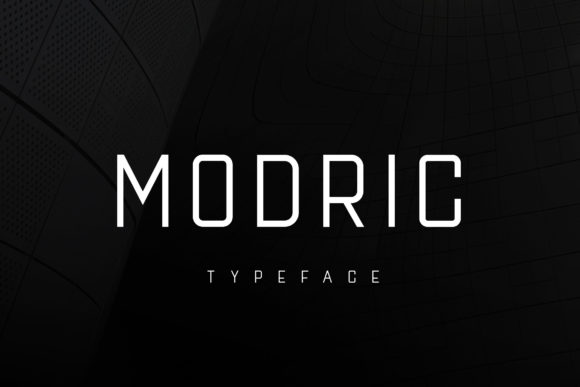
Modric is a custom-designed sans-serif display font characterized by its extended proportions, high stroke contrast, and tightly tuned letterfit. Its vertical stress and generous x-height give it stability without sacrificing dynamism; its terminals are clean but purposeful, never decorative for decoration’s sake. Unlike variable fonts or multi-weight families built for versatility across interfaces, Modric is deliberately focused: one weight, one width, one expressive intention. That narrow scope is its strength—not a limitation.
It doesn’t aim to support UI navigation, body copy, or responsive web typography. You won’t find light, italic, or condensed variants—and that’s by design. Modric exists where attention must be directed, not distributed. Its role is emphatic, not ambient.
Strengths in Real-World Application
Where Modric excels is in environments demanding instant legibility and tonal alignment. Consider a short-form video intro: a 3-second title reveal benefits from Modric’s rhythmic spacing and strong baseline emphasis. The letters hold their shape even when scaled down slightly or overlaid on motion-blurred backgrounds—no softening, no ambiguity.
In signage, especially illuminated or backlit applications, Modric’s open counters and consistent stroke endings reduce visual noise. Letters like A, e, and S remain distinct under uneven lighting or at oblique viewing angles—critical for retail displays or event banners viewed on the move.
For logo design, Modric offers a rare balance: it’s distinctive without being idiosyncratic. It avoids trendy quirks (no exaggerated terminals, no forced asymmetry) while still standing apart from generic geometric sans-serifs. Its rhythm supports custom ligatures or monogram integration, and its spacing responds well to kerning adjustments—important when fitting tight brand names like “Virel” or “Korva” into constrained lockups.
Quality and Technical Execution
Modric ships as a professionally hinted OpenType file with full Latin-1 support, standard ligatures, and discretionary stylistic sets—including alternate numerals optimized for tabular alignment. Glyph consistency is high: uppercase and lowercase share proportional logic without forcing false equivalence (e.g., the lowercase g retains personality without compromising hierarchy). Metrics are tight but breathable—tracking adjustments of ±10–20 units typically suffice for most large-format uses, avoiding the need for aggressive manual spacing.
Rendering is predictable across platforms. On macOS, it holds crispness at sizes above 48pt; on Windows, ClearType rendering remains stable down to ~36pt in print-resolution outputs. For digital signage or video export, embedding Modric in After Effects or Premiere Pro yields reliable rasterization—even with subtle drop shadows or glow effects applied in post.
Who Benefits Most—and Where It Fits Workflow
Freelance designers building brand identities for startups often face tight timelines and high expectations for memorability. Modric serves them well when a client needs “something strong but not aggressive, modern but not cold.” Its neutrality within boldness makes it adaptable across industries—from wellness studios seeking grounded authority to tech hardware brands wanting tactile precision.
Content creators producing premium YouTube intros or podcast cover art find Modric effective for thumbnail readability. At 1200×630px, even small text blocks (“Season 4 Launch”) retain impact without relying on outline effects or excessive contrast boosts—reducing post-production overhead.
Educators developing presentation decks for adult learners benefit from Modric’s clarity at distance. In hybrid classrooms or conference venues, slide headers set in Modric remain legible from 15+ feet away without requiring oversized point sizes that disrupt layout balance.
Small business owners updating storefront decals or vehicle wraps appreciate its scalability. A single Modric file works equally well on a 4-inch window decal and a 12-foot banner—no re-kerning, no redrawn letterforms, no version confusion.
Practical Considerations and Limitations
Modric is not suited for body text, captions under images, or data tables. Its spacing assumes generous line height and ample surrounding whitespace. Attempting to use it below 24pt in digital interfaces—or cramming it into narrow columns—undermines its intent and degrades readability.
It also assumes a degree of typographic literacy from the user. Because it lacks optical sizing variants or contextual alternates, achieving harmony with supporting text fonts requires deliberate pairing. We’ve found it pairs cleanly with neutral, low-contrast sans-serifs like Inter or IBM Plex Sans—not with high-contrast serifs or decorative display faces. Avoid stacking it with other bold display fonts; its presence dominates.
Licensing is straightforward: desktop + web use included in a single perpetual license. No subscription, no usage caps—but it does not include app embedding rights. If you’re shipping Modric inside a mobile application or SaaS dashboard UI, separate licensing applies.
Integration Tips for Better Results
- Respect its scale: Use Modric only where size and context allow its proportions to breathe—minimum 36pt for print, 48px for web headers, 72pt+ for signage.
- Control contrast intentionally: Pair with muted or desaturated background colors. Modric gains authority against deep navy, charcoal, or warm off-white—not pure black or bright pastels.
- Test at real viewing distance: Before finalizing a banner or poster, step back 10 feet. If letter spacing feels tight or individual glyphs blur together, increase tracking by 15–25 units—not font size.
- Use sparingly in motion: In video, limit Modric to static or slow-fade reveals. Rapid animation or heavy distortion undermines its structural integrity.
Final Assessment: Purpose Over Proliferation
Modric succeeds because it refuses to be everything. In an ecosystem crowded with endlessly customizable, multi-style font families, its singularity is functional—not aesthetic compromise. It solves a specific problem: how to occupy space decisively without shouting. That makes it valuable not just for what it renders, but for what it prevents—namely, visual indecision, weak hierarchy, or diluted brand tone.
If your work involves branding, motion graphics, environmental design, or any medium where first impressions are measured in milliseconds, Modric earns its place—not as a default, but as a considered choice. It asks for attention, then rewards it with clarity, consistency, and quiet authority. And in professional creative work, that kind of reliability—unflashy, uncompromising, and fit for purpose—is increasingly rare.