Artelis: The Handwritten Font That Adds Grace—Without the Guesswork
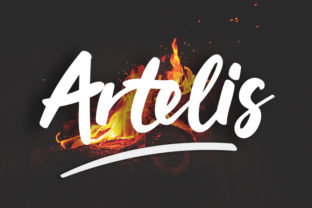
Artelis isn’t just another script font. It’s a carefully crafted handwritten typeface with elegant movement—fluid yet controlled, expressive yet legible. Its subtle variations in stroke weight and natural rhythm give it presence without pretension. Designers reach for Artelis when they want warmth and sophistication in equal measure: a wedding invitation that feels personal, a boutique logo that stands out quietly, or social media visuals that catch the eye without shouting.
Why Artelis Fits So Many Real-World Needs
Its versatility is genuine—not marketing fluff. Because Artelis balances character with clarity, it works where many scripts fail: on product labels with tight space constraints, as watermarks over photography (its open letterforms hold up well at low opacity), and even in short-form digital ads where readability at small sizes matters. Unlike overly ornate scripts, Artelis avoids excessive flourishes that blur at 16px—or worse, break entirely when converted to outlines in packaging software.
Mistake #1: Assuming “handwritten” means “casual”
Some users treat Artelis like a quick sketch font—slapping it onto tech startup logos or data dashboards expecting “personality.” But Artelis carries tonal weight. It leans into refinement, not informality. Using it for a fintech app interface or a no-nonsense B2B whitepaper can unintentionally undercut credibility. Instead, pair it with clean sans-serifs (like Inter or Manrope) for contrast: Artelis for headlines or signatures, neutral fonts for body copy and UI elements. That preserves its elegance while grounding your message.
Mistake #2: Overlooking spacing and kerning in real layouts
Artelis includes thoughtful default kerning—but those values assume standard use cases. When you scale it down for Instagram story text or stretch it across a wide banner, letters may crowd or drift apart unnaturally. Always test at final size and context. For example, a client once used Artelis for a coffee bag label at 8pt. The lowercase “a” and “e” nearly touched, making “bean” read as “be an.” A simple 20-unit tracking adjustment fixed it. Preview in your actual design tool—not just the font menu—and zoom in to check letter separation.
Mistake #3: Skipping the stylistic alternates
Artelis includes alternate characters (like a swash “Q”, a connected “Th”, or a simplified “g”)—but they’re not auto-enabled. Relying only on the default set misses half its expressive range. Use OpenType features in Adobe apps or modern web CSS (font-feature-settings: "salt") to access them deliberately. For a wedding monogram, try the swash capitals. For a minimalist skincare label, opt for the cleaner lowercase alternates. Don’t treat alternates as “extras”—they’re part of Artelis’ intended voice.
Mistake #4: Ignoring licensing scope
Artelis is available in both desktop and web-licensed versions—and they’re not interchangeable. If you’re building a Shopify store and plan to use Artelis in custom product badges or email headers, you need the web license (which covers hosted files and CDN delivery). Using a desktop-licensed file on a live site risks compliance issues and inconsistent rendering across browsers. Likewise, embedding Artelis in a mobile app or SaaS dashboard requires an extended license—not the standard one. Check the foundry’s license page *before* purchase, and match it precisely to your deployment method.
What to Verify Before You Commit
- File formats included: Does the package offer OTF (for design apps), WOFF2 (for fast web loading), and variable font support? Artelis’ current release includes all three—useful if you need responsive weight shifts without loading multiple files.
- Language coverage: Artelis supports Latin-based languages (including accented characters for French, Spanish, and German), but doesn’t include Cyrillic or Greek. If your brand serves multilingual audiences, confirm which glyphs are present—or budget for a complementary font where gaps exist.
- Technical compatibility: Test how Artelis renders in your workflow. Some older versions of Canva or Figma may not activate OpenType features by default. In email clients like Outlook, web fonts often fall back to system defaults—so always design with graceful degradation in mind (e.g., specify
font-family: "Artelis", "Segoe UI", sans-serif;).
Better Practices for Stronger Results
Start small. Try Artelis in one high-impact place first—a logo lockup, a hero headline, or a signature stamp—rather than applying it broadly across an entire brand system. This lets you assess how it interacts with your color palette, imagery, and audience expectations without overcommitting.
Print testing is non-negotiable. Artelis looks luminous on screen, but ink spread on uncoated paper can soften its delicate terminals. Order a physical proof of business cards or packaging mockups before mass production. You’ll notice how the “t” crossbar thickens or how the “y” descender fills in—adjusting letter spacing or choosing a slightly bolder weight often solves it.
For social content, avoid using Artelis in image-based posts *and* platform-native text overlays. Stick to one consistent application: either Artelis in your branded graphics (with fallback sans-serif in captions), or use it exclusively in video lower-thirds and static banners. Mixing it inconsistently confuses visual recognition—even subtle differences in rendering between Instagram’s native font engine and Photoshop exports dilute brand cohesion.
Final Thought: Let Artelis Lead—But Don’t Let It Carry Everything
Artelis earns its reputation because it does something rare: it adds grace without sacrificing function. But no font—no matter how beautifully drawn—can compensate for weak hierarchy, poor contrast, or mismatched tone. Use it where intention matters most: to welcome, to celebrate, to distinguish. Pair it thoughtfully. Test relentlessly. License correctly. And remember—the best designs don’t shout the font name; they let Artelis do what it does best: move the eye, soften the edge, and leave a quiet impression that lasts.