Saxophone Music: When Handwritten Energy Meets Strategic Design
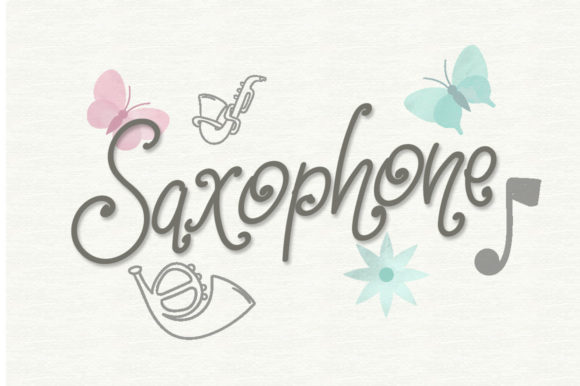
Music doesn’t always need notes to resonate — sometimes, it lives in the curve of a letter, the bounce of a baseline, the playful hesitation before a descender lands. Saxophone Music is more than a font. It’s a deliberate stylistic choice: a handwritten musical font with an unmistakable bouncy rhythm, organic flow, and gentle quirkiness. Its letters don’t march — they sway, lean, and breathe like a saxophonist shaping a phrase in real time. For professionals who rely on visual language to convey tone, authenticity, and intention — from educators crafting workshop handouts to small business owners designing event posters — Saxophone Music offers something rare: expressive warmth without sacrificing clarity.
Why This Font Fits Real-World Strategy (Not Just Aesthetics)
Strategic design isn’t about picking what looks “fun” — it’s about aligning visual tools with outcomes. Saxophone Music excels where human connection matters more than rigid uniformity: brand storytelling that invites rather than instructs, learning materials that reduce cognitive load through familiarity, or customer-facing touchpoints where approachability directly impacts engagement. Unlike highly structured sans-serifs built for scanning dense interfaces, Saxophone Music signals presence, care, and personality. That’s not decorative — it’s functional differentiation. In crowded digital spaces, that distinction supports recall, trust, and emotional resonance — all measurable contributors to long-term positioning.
Where It Delivers Practical Value
- Branding & Positioning: Small studios, creative agencies, and wellness practitioners use Saxophone Music for logo lockups or taglines when their differentiator is empathy, artistry, or intuitive guidance — not speed or scale. A yoga studio’s seasonal retreat flyer gains grounded warmth; a children’s literacy nonprofit’s donor newsletter feels personally penned, not templated.
- Learning & Communication: Educators report higher student engagement with handout headers set in Saxophone Music, especially in early childhood or special education contexts. The font’s irregularity mirrors natural handwriting, reducing the visual “barrier” some learners experience with mechanical type. It works best for short, high-impact text — section titles, key takeaways, motivational quotes — not body copy.
- Customer Experience: Physical touchpoints benefit most: packaging inserts, thank-you cards, limited-edition product labels. A ceramicist using Saxophone Music on a gift box tag reinforces craft and individual attention. Here, the font isn’t background noise — it’s part of the tactile narrative.
Timing Matters: When to Reach for Saxophone Music (and When Not To)
Like any expressive tool, Saxophone Music gains power through restraint and context. Use it when your goal is to soften formality, emphasize humanity, or add memorable texture to a moment of intentional pause. Avoid it when legibility, speed of comprehension, or broad accessibility are primary concerns — such as legal disclaimers, data dashboards, multilingual signage, or interfaces used by people with low vision. Its charm lies in its imperfection; its limitation is that same quality. That’s not a flaw — it’s a constraint to plan around.
Consider these practical filters before applying Saxophone Music:
- Is this text meant to be read quickly or savored slowly? If it’s directional (e.g., “Exit →”), choose clarity. If it’s evocative (“Breathe in. Begin.”), Saxophone Music earns its place.
- Does the audience expect consistency across channels? Using it exclusively on Instagram Stories but not email headers creates fragmentation. Align usage with your broader typographic hierarchy — e.g., Saxophone Music for headlines only, paired with a highly legible serif or sans-serif for body text.
- Is there a clear emotional objective? “Friendly,” “playful,” or “thoughtful” are valid. “Authoritative,” “urgent,” or “technical” are not. Let the goal drive the choice — not the novelty.
Execution Tips That Prevent Misfire
Intentional use starts with technical discipline. Saxophone Music includes OpenType features like alternate characters and ligatures — but enabling them all at once can overwhelm. Test combinations: try swapping just the uppercase “Q” or “R” for a more dynamic headline, while keeping lowercase letters standard for better rhythm. Kerning often needs manual adjustment; letters like “f” and “l” may collide or gap unexpectedly. Always preview at actual size — what reads as charming at 48pt can become indecipherable at 14pt on mobile.
Also consider pairing. Saxophone Music thrives beside typefaces with quiet confidence: a warm, slightly rounded sans-serif (like Poppins or Quicksand) for supporting text, or a crisp, low-contrast serif (like Lora or Merriweather) for contrast that feels curated, not chaotic. Never pair it with another highly decorative font — the visual competition dilutes impact.
Risks of Using Saxophone Music Without Strategy
Without clear goals, Saxophone Music can unintentionally signal inconsistency, informality where professionalism is expected, or even unseriousness — especially in B2B contexts where credibility hinges on precision. One freelance designer learned this when a fintech client rejected a pitch deck using Saxophone Music for section headers: the font clashed with the audience’s expectation of analytical rigor, regardless of how beautifully it was implemented. The issue wasn’t the font — it was the mismatch between visual tone and strategic context.
Another risk is overuse fatigue. Because Saxophone Music carries strong personality, repeated exposure without variation dulls its effect. A blog that sets every subhead in the font loses its punch within three posts. Its power resides in scarcity — in being the exception, not the rule.
Building Long-Term Value Around the Choice
Treat Saxophone Music as a signature accent — not a default. Document *why* and *where* you use it in your brand guidelines: “Used only for workshop titles and handwritten-style callouts in print materials targeting K–5 educators.” That specificity prevents drift and ensures continuity across team members or contractors. Revisit usage annually: does it still reflect your evolved positioning? Has audience feedback revealed unexpected friction? Does it still serve the outcome you intended — or has it become habit?
Long-term value also emerges when you let the font inspire adjacent decisions. Its bouncy rhythm might prompt you to rethink spacing — adding more generous line height or margin breathing room to echo its lightness. Its handwritten nature could nudge you toward incorporating subtle, purposeful imperfections elsewhere: a slightly uneven border, hand-drawn icons, or analog textures in digital assets. The font becomes a north star for holistic tone — not just typography.
Final Thought: Let It Dance — But Only Where the Music Calls For It
Saxophone Music doesn’t need to be everywhere to matter. Its strength is in precision — in knowing exactly which words deserve to sway, which messages earn a breath before landing, which audiences will feel seen because the type feels like it was made *for them*, not just *at them*. That requires listening first: to your goals, your audience’s expectations, and the quiet logic of your communication ecosystem. When you do, Saxophone Music stops being a decorative flourish and becomes a strategic instrument — one that doesn’t shout, but leans in, makes eye contact, and says something true.