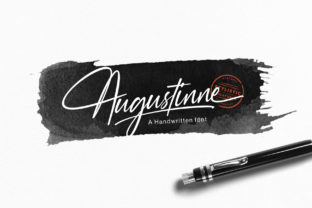
Augustinne
Augustinne is a spacious, comfortable script font—designed not just to look elegant, but to breathe on the page. It’s not the kind of script that feels fussy or overly formal; instead, it carries warmth and quiet confidence. Letters have generous spacing, soft curves, and a natural rhythm—like handwriting you’d want to pause and admire. That balance makes Augustinne especially effective where legibility meets personality: when you need text to feel personal *and* hold its own visually.
Where Augustinne Fits Naturally—Not Just “Looks Nice”
Fonts aren’t chosen in a vacuum—they’re selected for how they serve an intention. Augustinne shines brightest when the goal is connection, not decoration. Think about moments where tone matters as much as content: a wedding invitation that whispers intimacy, a small-batch soap label that feels handmade, a signature on a limited-edition book cover that lingers in memory.
For Creators & Small Business Owners
If you design your own product packaging, craft seasonal greeting cards, or sell prints online, Augustinne helps your work stand out without shouting. Its open letterforms scale beautifully—even at small sizes on jar labels or tags—so “Hand-poured Lavender Honey” stays readable and inviting. One ceramicist told us she switched from a tighter script to Augustinne for her studio logo and saw a noticeable uptick in customer comments like “It feels like it was made just for me.” That’s not accidental—it’s spacing, weight, and rhythm working together to signal care.
For Authors & Publishers
Book covers live in crowded feeds and narrow thumbnails. Augustinne handles both: its vertical clarity keeps titles legible even when shrunk for Amazon previews, while its organic flow adds texture to genre-blending fiction or memoirs with lyrical voices. A nonfiction author using Augustinne for her subtitle (“A Gentle Guide to Unlearning Burnout”) found readers consistently mentioned how the font “felt like permission”—a subtle reinforcement of her message before a single word was read.
For Event Planners & Stationers
Invitations are emotional first impressions. Augustinne avoids the stiffness of calligraphic fonts that demand perfect alignment—and the fragility of ultra-thin scripts that vanish under certain printing methods. It holds up across paper stocks (linen, cotton, kraft) and print techniques (letterpress, foil stamping, digital). Real-world note: one planner reported fewer client requests for font revisions after switching to Augustinne—because guests actually *noticed* and remembered the name of the couple, not just the date.
Real Situations Where Spacing Changes Everything
What makes Augustinne “spacious” isn’t just visual—it’s functional. Consider these everyday scenarios:
- Frame-worthy quotes: When someone prints a line like “Breathe deep, begin again” for their home office wall, tight letters can feel cramped. Augustinne gives each word room to land—making the sentiment feel more generous, less hurried.
- Signature lines on contracts or certificates: Legal or ceremonial documents often use scripts that prioritize tradition over clarity. Augustinne strikes a middle ground—recognizable as a signature style, yet legible enough to avoid second-guessing (“Is that an ‘r’ or an ‘n’?”).
- Restaurant menus or café chalkboard graphics: Even digitally rendered “handwritten” menus benefit from Augustinne’s consistent x-height and open counters. Diners scanning quickly still catch “roasted beet hummus” or “oat milk latte” without slowing down.
Who Might Want to Pause Before Using Augustinne
Like any tool, Augustinne has sweet spots—and edges worth acknowledging.
It’s not ideal for body text in long-form digital reading (think blog posts or e-newsletters), where consistent letter spacing and high contrast aid screen scanning. Nor does it replace highly structured sans-serifs in data-heavy contexts—dashboards, technical manuals, or multilingual interfaces where uniform character width supports quick parsing.
Also worth noting: Augustinne’s comfort comes partly from its moderate contrast between thick and thin strokes. That means it performs best in medium-to-light weights. If you’re layering it over busy photography or textured backgrounds, test early—its gentle weight can recede where bolder fonts would pop.
Practical Tips for Getting It Right
You don’t need design expertise to use Augustinne well—just attention to context.
- Pair it thoughtfully: It harmonizes beautifully with clean, uncluttered sans-serifs (like Inter, Lato, or Poppins) for contrast without competition. Avoid pairing it with other scripts—especially those with dramatic flourishes—unless you’re aiming for intentional, curated eclecticism.
- Respect its rhythm: Augustinne reads best with generous line height (1.4–1.6) and slightly wider letter spacing than typical scripts—especially in all-caps applications. Tight tracking can mute its airy quality.
- Test across outputs: Print a sample on your intended paper stock. Render it at 12px, 24px, and 60px on screen. See where it gains presence—and where it starts to soften too much. Most users find it most expressive between 18–48pt for display use.
Why “Comfortable” Isn’t Just a Buzzword Here
In design, comfort isn’t about softness—it’s about reducing friction. Augustinne reduces friction between reader and message. A bride doesn’t need to squint at her save-the-date. A bookstore shopper shouldn’t hesitate before picking up a novel because the title feels hard to parse. A local maker shouldn’t worry whether “Small Batch • Made in Portland” will get lost on a brown paper bag.
That comfort extends behind the scenes, too. Designers report faster client approvals when using Augustinne—not because it’s safe, but because it feels *considered*. It suggests intentionality without pretense. And for people who aren’t designers? It simply feels welcoming. Not flashy. Not cold. Just right-sized for human attention.
Whether you’re choosing a font for your first Etsy shop, redesigning your therapy practice’s intake forms, or hand-lettering a friend’s baby announcement—Augustinne offers space to be seen, clearly and kindly.