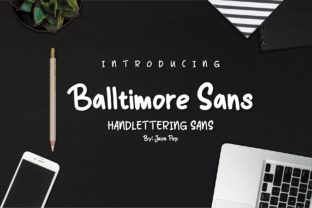
Balltimore: The Hand-Lettered Sans That Bridges Authenticity and Utility
Typography is rarely neutral. Even the most restrained sans-serif carries intention—whether it’s efficiency, authority, or approachability. Balltimore stands apart not by rejecting function, but by redefining how warmth and clarity coexist in digital and physical design. It’s a hand-lettered sans font—not a script, not a display typeface masquerading as functional, but a carefully crafted, rhythmically consistent sans built from deliberate human gesture. Its name evokes both craft and place: “Ball” suggesting rounded, tactile form; “timore” echoing resonance, quiet confidence. This isn’t just branding wordplay—it reflects the font’s core behavior on the page and screen.
What Makes Balltimore Distinctly Hand-Lettered—Without Sacrificing Legibility
Many fonts labeled “hand-drawn” lean heavily into irregularity: uneven stroke weights, unpredictable terminals, or inconsistent x-heights that compromise readability at small sizes or in dense text. Balltimore avoids that trap. Its hand-lettered quality emerges in subtle, repeatable ways: slightly softened corners where strokes meet, gentle tapering at stroke ends (rather than sharp cuts or blunt caps), and a rhythmic variation in vertical stress that mimics natural pen pressure—not randomness. Each glyph was drawn by hand first, then meticulously vectorized and spaced to ensure even color, consistent metrics, and reliable performance across devices.
Consider its lowercase ‘a’ or ‘g’: open counters, generous apertures, and friendly proportions invite extended reading without fatigue. Uppercase letters maintain presence without dominance—the capital ‘B’, for example, balances a confident curve with an uncluttered interior space. There are no decorative flourishes or forced quirks. Instead, Balltimore’s personality lives in restraint: the slight swell of the ‘n’ stem, the soft landing of the ‘t’ crossbar, the way the ‘r’ leg lifts with quiet momentum. These aren’t arbitrary details—they’re the residue of human attention, translated into scalable, dependable form.
Where Balltimore Earns Its Place: Practical Use Cases Across Contexts
Because Balltimore merges expressive character with structural integrity, its applications span environments where tone and trust matter equally.
- DIY and maker communities: From laser-cut greeting cards to embroidered tote labels, Balltimore adds tactile credibility. A hobbyist printing plant care tags doesn’t need sterile uniformity—they need something that feels made, not generated. Balltimore delivers that impression while remaining crisp at 12 pt on matte paper or vinyl cutters.
- Educational materials: Teachers designing classroom posters, worksheets, or digital slide decks often struggle with fonts that feel either too childish or too corporate. Balltimore’s balanced warmth supports learning without condescension. Its clear letterforms reduce visual decoding load for emerging readers, while its mature proportions keep content feeling respectful and inclusive.
- Small business identity: A neighborhood bakery, ceramic studio, or independent bookstore benefits from typography that signals care without pretense. Balltimore works beautifully in logos (especially when paired with a clean secondary sans for body copy), packaging labels, and social media graphics. Unlike overly casual scripts, it scales reliably from Instagram story text to café chalkboard signage.
- Digital interfaces with human emphasis: While not intended as a UI system font, Balltimore excels in targeted interface moments—onboarding headlines, feature callouts, or testimonial banners—where you want users to pause and feel invited, not instructed. Its even spacing ensures readability in responsive layouts, and its OpenType features (including true small caps and stylistic alternates) allow nuanced voice shifts without switching families.
Technical Strengths That Support Real-World Workflows
Adopting a new font isn’t just about aesthetics—it’s about integration. Balltimore was engineered with modern production in mind:
- Cross-platform consistency: Tested rigorously on macOS, Windows, iOS, and Android, Balltimore renders predictably whether embedded in a Figma prototype, a Notion page, or a WordPress theme. No unexpected hinting artifacts or missing glyphs mid-project.
- Web performance optimized: Available in WOFF2 format with subsetting options, it loads swiftly even on bandwidth-constrained connections. Designers can serve only the characters needed (e.g., Latin + basic punctuation) without bloating page weight.
- Language support beyond English: Includes full Latin-1 and Latin-Extended-A coverage—supporting French, Spanish, German, Portuguese, Polish, Turkish, and more. Accented characters like ‘ñ’, ‘ç’, and ‘ż’ retain the same organic stroke logic as base letters, preserving visual harmony in multilingual content.
- Variable axis readiness: While the current release is static, the underlying design system was built with interpolation in mind. Future iterations may introduce weight or width axes—enabling dynamic typographic responses in adaptive layouts without sacrificing Balltimore’s foundational character.
Designing With Intention: When—and When Not—to Choose Balltimore
Like any thoughtful tool, Balltimore reveals its value most clearly when matched to appropriate challenges. It shines brightest when the goal is human-centered communication: conveying care, authenticity, or grounded creativity. It’s less suited for contexts demanding absolute neutrality (e.g., legal disclaimers requiring maximum legibility at 8 pt) or high-density data tables where geometric precision outweighs expressive nuance.
A practical observation: Balltimore performs exceptionally well in mixed-media projects. For instance, a community garden initiative might use Balltimore for its printed seasonal newsletter headline and workshop handouts, then switch to a highly legible sans (like Inter or Roboto) for planting schedules and safety instructions. That contrast isn’t inconsistency—it’s strategic layering. Balltimore sets the emotional tone; supporting fonts handle functional clarity. This kind of typographic choreography builds coherence without monotony.
Another real-world insight comes from educators using Balltimore in student-facing materials. One third-grade teacher reported that when rewriting standardized test practice sheets in Balltimore (instead of default Arial), students engaged more readily with reading passages—particularly those who previously avoided extended text tasks. She attributed this not to novelty alone, but to the font’s “breathing room”: generous letter spacing, open shapes, and absence of visual aggression. It didn’t lower cognitive demand—but it lowered perceptual resistance.
Accessibility Considerations Grounded in Practice
Typography accessibility extends beyond contrast ratios and font size. Balltimore supports inclusive design through intentional form decisions. Its distinct ‘I’, ‘l’, and ‘1’—each with unique proportions and terminal treatments—reduces character confusion, especially for users with dyslexia or low vision. The lowercase ‘a’ and ‘o’ avoid closed loops that can appear filled in low-resolution displays; instead, they feature subtle openings that preserve shape recognition. Ascenders and descenders are generously proportioned, preventing crowding in line heights common with tightly spaced system fonts.
That said, accessibility isn’t automatic—it’s relational. Balltimore should be paired with sufficient line height (at least 1.5× font size), adequate contrast (minimum 4.5:1 against background), and thoughtful hierarchy. Using Balltimore for body text at 14 pt with 1.6 line height and #333 on off-white (#f9f9f7) creates a reading environment that feels both inviting and sustainable. These choices reflect experience, not just compliance—a distinction central to E-E-A-T principles.
Looking Ahead: How Balltimore Fits Into Evolving Design Priorities
As digital experiences grow more algorithmically driven, there’s a quiet counter-movement toward human-scaled design—interfaces that acknowledge attention as finite, emotion as relevant, and craft as meaningful. Balltimore aligns with this shift not as nostalgia, but as forward-looking utility. Its hand-lettered roots aren’t a retreat from technology; they’re a calibration of it. In an era of AI-generated visuals and templated layouts, choosing Balltimore signals intentionality: a decision to prioritize resonance over replication, clarity over conformity.
This matters across sectors. A researcher publishing open-access science communication might use Balltimore for article titles and pull quotes—making complex ideas feel approachable without diluting rigor. A nonprofit crafting donor impact reports could employ it in section headers and quote attributions, reinforcing trust through visual warmth. Even in enterprise settings, internal change initiatives benefit from typography that feels grounded—not coldly procedural, but thoughtfully human.
Ultimately, Balltimore’s strength lies in its quiet versatility. It doesn’t shout. It doesn’t imitate handwriting. It doesn’t chase trends. Instead, it offers a stable, expressive foundation—one that supports diverse voices, accommodates real constraints, and remains legible across generations of devices and readers. That balance—between the handmade and the highly functional—is rare. And increasingly, indispensable.