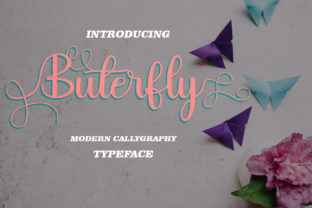
Buterfly: A Modern Handwritten Calligraphy Font
Buterfly is a modern calligraphy font designed to replicate the fluidity and expressiveness of natural handwriting. Unlike digitized script fonts built from geometric shapes or vector paths, Buterfly was originally handwritten—then carefully digitized—to preserve organic line variation, subtle pressure shifts, and rhythmic spacing. Its letterforms balance elegance with approachability, featuring soft terminals, gentle swashes, and consistent yet humanistic proportions. As a result, Buterfly occupies a distinct space among contemporary script fonts: neither overly formal nor excessively casual, but intentionally grounded in the authenticity of hand-drawn lettering.
Why Designers Consider Buterfly
Designers often seek fonts that communicate tone as much as function. Buterfly appeals most when the goal is to evoke warmth, individuality, or artisanal craftsmanship—qualities difficult to achieve with rigid sans-serif or highly structured serif typefaces. Its natural writing style makes it especially relevant for projects where perceived effort, care, or personal voice matters: wedding stationery, boutique branding, editorial features on lifestyle or wellness topics, or packaging for small-batch food and beverage products.
Because it’s rooted in real handwriting, Buterfly avoids the mechanical repetition common in algorithmically generated scripts. Letters retain slight irregularities in angle, weight, and spacing—details that signal human intention rather than digital uniformity. This characteristic supports visual storytelling, particularly in contexts where audiences value authenticity over polish.
Practical Benefits and Realistic Expectations
One clear benefit of Buterfly is its legibility at moderate sizes. While many decorative scripts sacrifice readability for flair, Buterfly maintains open counters and generous x-heights, allowing it to function effectively in headings, short quotes, or product labels without requiring excessive tracking or leading adjustments. Its standard OpenType features include ligatures and contextual alternates, enabling smoother word shapes and reducing visual monotony across longer phrases.
However, users should expect limitations. Buterfly is not intended for body text or extended reading. It lacks a full set of small caps, tabular figures, or extensive language support beyond basic Latin characters. Its character set covers Western European languages adequately but does not extend to Cyrillic, Greek, or extended diacritical marks used in Vietnamese or Turkish. Users working on multilingual projects—or those needing robust typographic hierarchy—will likely need to pair Buterfly with a complementary sans-serif or serif font for supporting text.
Another consideration is licensing. Buterfly is typically offered under commercial licenses that permit use in client work, digital ads, and print materials—but restrictions may apply for app embedding, web font hosting, or merchandise resale. Reviewing the specific license terms before implementation helps avoid compliance issues later.
When Buterfly Fits Well
Buterfly performs best in focused, intentional applications. It shines in logo design for creative studios, yoga studios, or handmade goods brands where visual harmony with photography or watercolor textures is essential. Its rhythm complements minimalist layouts, adding texture without overwhelming negative space. In editorial design, it works effectively for pull quotes, chapter titles, or section dividers—especially when paired with a neutral, highly legible text face like Lora, Inter, or Source Serif.
It also suits social media graphics where quick visual impact matters. A single-line headline in Buterfly over a muted background can convey sophistication and calm—useful for mindfulness apps, sustainable fashion campaigns, or artisanal coffee branding. Because its forms are relatively restrained (no extreme flourishes or exaggerated ascenders), it scales well across devices and retains recognizability even at smaller viewport sizes.
When Alternatives May Be More Suitable
Buterfly is less appropriate when consistency, neutrality, or functional clarity takes priority over stylistic expression. For corporate identity systems requiring strict typographic control across departments, a more versatile script—or no script at all—may serve better. Similarly, accessibility considerations matter: while Buterfly meets basic contrast requirements, its variable stroke widths and connected forms may reduce legibility for some readers with low vision or dyslexia. In such cases, a tested, dyslexia-friendly sans-serif remains the responsible choice for primary text.
Designers seeking broader language coverage, tighter kerning control, or advanced OpenType features (like stylistic sets or fractions) might explore alternatives such as Playfair Display (for contrast-rich serif pairing), Quicksand (for friendly, rounded sans-serif balance), or Great Vibes (for a more ornate, traditional script). Each offers different tradeoffs: Great Vibes delivers stronger calligraphic drama but sacrifices some versatility; Quicksand provides wider language support but lacks handwritten nuance.
Making an Informed Choice
Before selecting Buterfly, ask three practical questions:
- What is the primary role of typography in this project? If conveying personality or emotional resonance is central—and the text volume stays low—Buterfly aligns well.
- What environments will this appear in? Test how it renders across browsers, mobile screens, and print outputs. Some handwritten fonts degrade in low-resolution settings; Buterfly generally holds up, but verification is essential.
- Does the project require long-term flexibility? If future expansions—such as multilingual versions, interactive components, or voice interface compatibility—are anticipated, confirm whether Buterfly’s technical constraints match those needs.
Sampling Buterfly in context helps clarify fit. Try setting real content—not placeholder text—in your layout software. Observe how it interacts with imagery, color palettes, and surrounding type. Does it enhance hierarchy, or compete with other elements? Does its rhythm support the pacing of your message—or slow it down unintentionally?
Finally, consider workflow implications. Buterfly works smoothly in Adobe Creative Cloud applications and modern CSS environments via @font-face. However, designers using Figma or Sketch should verify plugin compatibility and export behavior, particularly when sharing files with collaborators who may not have the font installed.
In summary, Buterfly stands out for designers who prioritize expressive, human-centered typography in targeted applications. It is not a universal solution, nor is it meant to replace system fonts or workhorse text faces. Instead, it serves a precise purpose: bringing natural writing energy into carefully considered design moments. Evaluating it alongside project goals—not just aesthetic preference—leads to more confident, effective type choices.