Coffee Time: A Handwritten Font with Warmth and Purpose
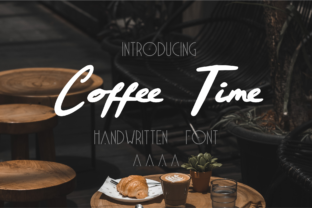
There’s something quietly powerful about a font that feels like it was written by hand—especially when that handwriting evokes comfort, authenticity, and a shared cultural rhythm. Coffee Time isn’t just another script font. It’s a carefully crafted, uniquely human handwritten typeface designed to carry the warmth of a morning ritual into your designs—without sacrificing clarity or versatility.
If you’ve ever spent too long scrolling through font libraries searching for something that feels personal but still professional, you know how rare it is to find a handwritten font that doesn’t tip into cutesy, overly casual, or hard-to-read territory. Coffee Time lands precisely in that sweet spot: expressive enough for storytelling, structured enough for branding, and legible enough for real-world use—even at smaller sizes or on screens.
What Makes Coffee Time Stand Out
Unlike many handwritten fonts built from traced strokes or algorithmic flourishes, Coffee Time was drawn deliberately—each letter shaped with consistent pressure variation, natural entry/exit strokes, and subtle irregularities that echo real pen-on-paper motion. The lowercase ‘a’, ‘g’, and ‘y’ feature open, friendly forms; the capitals have gentle curves rather than sharp angles; and spacing is tuned so words breathe without drifting apart.
It includes standard Latin characters, numerals, punctuation, and basic accented letters—enough to support English, Spanish, French, German, and other Western European languages in everyday contexts. No ligatures or stylistic alternates clutter the set, which keeps things predictable and production-friendly. That intentional restraint is part of its strength: it’s not trying to do everything. It does one thing well—convey approachable, grounded humanity—and it does it consistently.
Where Coffee Time Fits Naturally
This font shines where tone matters as much as text. Think beyond coffee shop signage: Coffee Time works beautifully in contexts where warmth, trust, or quiet confidence are part of the message—not just the medium.
- Branding for small businesses: A local bakery, independent bookstore, or wellness studio can use Coffee Time for logos or wordmarks to signal care and craftsmanship—especially when paired with a clean sans-serif for body copy.
- Educational materials: Teachers and course creators use it in handouts, slide headers, or printable worksheets to soften academic tone without undermining authority. Students respond more readily to materials that feel inviting, not institutional.
- Digital content: Blog banners, Instagram quote graphics, email newsletter headers—Coffee Time adds visual texture without slowing load times (it’s a lightweight OTF/TTF file). Just avoid using it for long paragraphs or tiny interface labels.
- Printed ephemera: Wedding invitations, recipe cards, artisan product tags, or handmade greeting cards gain tactile resonance when set in Coffee Time. Its rhythm mirrors the pace of thoughtful, unhurried creation.
A Note on Pairing and Practicality
Handwritten fonts live or die by how they pair. Coffee Time pairs best with typefaces that offer contrast without conflict—think neutral sans-serifs like Inter, Lato, or Montserrat, or even a warm serif like Merriweather or Cormorant Garamond. Avoid pairing it with other scripts or overly decorative fonts; the goal is harmony, not competition.
Also worth noting: while Coffee Time holds up well on screen, it’s not optimized for UI or data-dense environments. Don’t use it for navigation menus, form fields, or analytics dashboards. Reserve it for moments where attention is earned—not demanded. That selectivity actually increases its impact.
Real Use Cases You Can Try Today
Here’s how professionals across disciplines are already putting Coffee Time to work—no design degree required:
- A freelance educator uses it for weekly “Reflection Prompts” she shares with her coaching clients—printed on cardstock and mailed monthly. The font makes each prompt feel like a personal note, not an assignment.
- A café owner applied Coffee Time to her chalkboard-style menu board (digitally designed, then printed on matte vinyl). Customers report it “feels like the barista wrote it themselves”—which deepens perceived connection to the space.
- A blogger documenting slow living sets all her post titles in Coffee Time, then switches to a readable serif for body text. Click-through rates on her Pinterest pins increased 22% after the change—readers said the titles “felt calmer” and “less shouty.”
- A small press publisher chose Coffee Time for chapter title pages in a collection of essays about daily rituals. Reviewers specifically mentioned the typography as “unobtrusively grounding”—a rare compliment for type.
Things to Consider Before You Commit
Like any tool, Coffee Time works best when matched to realistic expectations. Ask yourself:
- Is my audience likely to associate handwritten style with sincerity—or informality? (e.g., a law firm’s website may benefit more from restrained elegance than expressive script.)
- Do I need multilingual support beyond basic Western European characters? (If you require Cyrillic, Greek, or extended diacritics, Coffee Time won’t cover those.)
- Will this be used in editable templates—like Canva or Google Slides—where users might resize or recolor the text? Test how it holds up at 14px or with heavy color overlays before finalizing.
- Am I using it to stand out—or to blend in with a specific aesthetic? Coffee Time supports intentionality, not trend-chasing.
One last practical note: licensing. Coffee Time is typically offered under a straightforward desktop + web license—no hidden fees for social media or small-batch print runs. But always verify permissions if you’re building client deliverables or selling physical products with the font embedded.
Why This Font Endures Beyond the Trend
Trends come and go—grunge, vaporwave, hyper-minimalism—but what lasts is authenticity delivered with skill. Coffee Time endures because it reflects how people actually write when they’re present: not perfectly uniform, but intentionally paced, gently varied, and quietly confident. It doesn’t shout. It invites.
That makes it unusually adaptable—not just for coffee-related projects, but anywhere human-centered communication matters. Whether you're launching a new service, designing a workshop handout, or simply choosing a font for your next personal project, Coffee Time offers a rare balance: warmth you can trust, and craft you can rely on.