Leonie
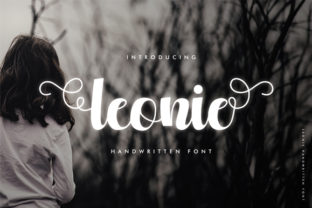
Leonie is a handwritten font that feels both intentional and effortless — warm, legible, and expressive without sacrificing clarity. It’s not merely decorative; it carries tonal weight. When you choose Leonie, you’re not just selecting a typeface — you’re choosing a subtle but meaningful signal about voice, care, and human-centered communication. That makes it especially valuable for professionals who rely on authenticity as a differentiator: educators building trust with students, small business owners crafting memorable first impressions, freelancers positioning themselves as approachable experts, or marketers designing campaigns where emotional resonance matters as much as message.
Strategic Value Beyond Aesthetics
Typography shapes perception before a single word is read. Leonie’s gentle curves, consistent stroke contrast, and natural rhythm support goals tied to connection and credibility — not just visual appeal. Unlike overly stylized scripts that sacrifice legibility at small sizes or in dense layouts, Leonie maintains readability across contexts: from a signature on a client proposal to a quote on a social media graphic. Its balance of personality and professionalism means it can reinforce brand values without demanding attention for its own sake.
This matters most when consistency compounds over time — in email signatures, presentation decks, printed materials, or digital assets. Each repetition builds recognition. But only if applied with intention. Using Leonie haphazardly — say, as body text in a long-form blog post or stacked tightly in a mobile navigation bar — undermines its strengths and dilutes its impact. Strategic use begins with alignment: Does this application serve clarity? Does it reflect the tone your audience expects? Does it support, rather than compete with, your core message?
Where Leonie Delivers Measurable Outcomes
Consider these high-leverage applications, grounded in real-world decision-making:
- Client-facing documents: A Leonie headline on a project proposal or service agreement adds warmth without compromising authority — helping prospects feel seen while still perceiving competence.
- Branded merchandise: On t-shirts, tote bags, or enamel pins, Leonie transforms functional items into tactile extensions of identity. Its hand-drawn quality invites touch and recall, supporting long-term brand memory better than generic sans-serifs.
- Invitations and event materials: Whether for a workshop, product launch, or community gathering, Leonie signals thoughtfulness. Attendees subconsciously register the extra care invested — raising perceived value and engagement likelihood.
- Digital signage and posters: In physical spaces like co-working lounges, classrooms, or retail environments, Leonie improves scannability at distance while preserving approachability — crucial when competing for attention without overwhelming.
- Signature elements: Used sparingly in email footers, letterheads, or video watermarks, Leonie becomes a quiet signature — reinforcing ownership and consistency without shouting for attention.
When Not to Use Leonie (and Why It Matters)
Leonie isn’t a universal solution — and recognizing its limits is part of using it well. Avoid it in contexts where neutrality, speed of comprehension, or strict accessibility standards are non-negotiable. For example:
- Long-form web copy or legal disclaimers — where screen readers and reading fluency depend on predictable letterforms.
- UI buttons or navigation labels — where immediate recognition trumps stylistic nuance.
- Situations requiring multilingual support across complex scripts — Leonie’s design focuses on Latin-based languages and may not scale reliably elsewhere.
Misapplication doesn’t just reduce effectiveness — it risks misalignment. A startup using Leonie for error messages or dashboard alerts sends conflicting signals: “We value warmth” while delivering friction. That disconnect erodes trust faster than any typographic choice alone.
Intentional Integration Starts With Planning
Before adding Leonie to your toolkit, ask three questions:
- What outcome do I want this element to support? Is it memorability? Emotional resonance? Differentiation from competitors? Clarity of hierarchy? Name it concretely — not “it should look nice,” but “this headline must increase click-through by signaling personal relevance.”
- Where will this appear — and under what conditions? Will it be viewed on a retina display or printed at 72 dpi? Will it sit beside bold sans-serif headings or delicate serif body text? Test contrast, spacing, and sizing early — not after finalizing layouts.
- How does this fit within my broader system? If your brand uses geometric sans-serifs for headlines and clean serifs for body text, introducing Leonie works best as an accent — not a replacement. Think of it as punctuation, not prose.
One practical planning tip: Create a “Leonie usage charter” — a short internal document listing approved applications (e.g., “only for primary headlines in print collateral,” “permitted in social graphics up to 48px”), prohibited uses (e.g., “never in data tables or form fields”), and fallbacks (e.g., “if Leonie isn’t available, use Lora Regular at 110% tracking”). This prevents drift and preserves strategic coherence.
Long-Term Branding Considerations
Fonts accrue meaning over time. Leonie gains value the more consistently and contextually it appears — but only if those appearances reinforce the same underlying idea. For instance, a therapist using Leonie across session summaries, website headers, and workshop handouts builds a cohesive impression of empathy-in-action. A SaaS company applying it only to holiday emails creates fragmentation — suggesting seasonal whimsy rather than enduring values.
Also consider scalability. As your audience grows or channels diversify (e.g., launching a podcast, entering new markets), ask whether Leonie still serves your evolving goals. A font that strengthens intimacy in one-to-one communications may weaken authority in enterprise sales decks. That doesn’t mean retiring it — but redefining its role. Perhaps it shifts from headline font to signature motif, or from digital asset to physical touchpoint only.
Productivity and Creative Discipline
Ironically, limiting Leonie’s use often increases its impact — and frees mental bandwidth. When every heading defaults to the same script, decisions stall. But with clear boundaries (“Leonie only for quotes in blog posts,” “exclusively for client thank-you notes”), creative energy redirects toward content, structure, and strategy — not endless font toggling.
That discipline pays off operationally too. Design systems with defined roles for Leonie reduce revision cycles, improve cross-team alignment (e.g., marketing and design agreeing on usage rules), and simplify onboarding for contractors or new hires. You’re not just choosing a font — you’re building infrastructure for consistency.
Final Thought: Typography as Quiet Strategy
Leonie succeeds not because it’s “cute” or “beautiful” in isolation — but because it supports specific human outcomes: making someone feel welcomed, remembered, or understood. Its power lies in restraint, context, and alignment with purpose. Use it to soften edges where warmth is needed. Use it to highlight humanity where automation dominates. Use it to distinguish your voice — not from noise, but from indifference.
The most effective applications of Leonie won’t draw attention to the font itself. They’ll make the reader pause — not because the letters are unusual, but because the message landed with uncommon clarity and care.