Parallel Lines: A Distinctive Display Font for Expressive Visual Identity
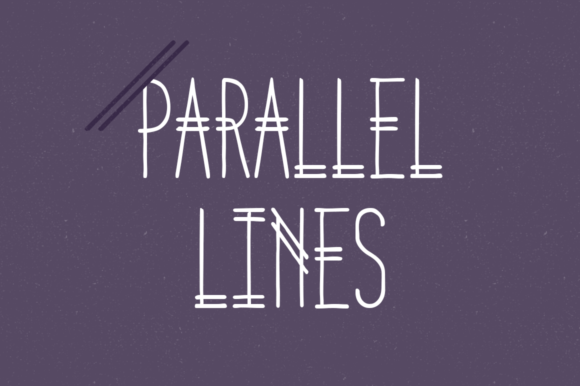
Typography is rarely neutral—it carries tone, signals intention, and shapes perception before a single word is read. Among display fonts designed to command attention while retaining personality, Parallel Lines stands apart not through complexity, but through deliberate restraint and subtle craftsmanship. It is a handwritten-style typeface defined by its signature dual-stroke construction: two parallel, slightly irregular lines trace each character, evoking the fluidity of ink on paper—but with the precision of digital design. Its slender proportions and rhythmic spacing make it inherently suited for large-scale applications where legibility at distance and emotional resonance matter equally.
What Makes Parallel Lines Visually Distinctive
The defining trait of Parallel Lines lies in its foundational structure—every glyph is drawn using two synchronized strokes that run in parallel, never converging or diverging dramatically. This isn’t a simulated effect applied post-drawing; it’s baked into the vector outlines from the outset. The result is a sense of handmade authenticity without the unpredictability of true calligraphy. Letters retain organic variation—subtle fluctuations in stroke weight, slight tapering at terminals, and gentle curvature in curves—but remain consistently balanced and harmonious across the character set.
This duality—handwritten warmth paired with structural discipline—gives Parallel Lines an unusual versatility. Unlike many script fonts that lean heavily into flourish or formality, it occupies a middle ground: expressive enough for creative branding, yet disciplined enough for editorial headlines or institutional signage. Its narrow width further enhances its utility in constrained horizontal spaces—think banner ads, mobile app headers, or responsive web hero sections—where wider scripts would break awkwardly or require excessive scaling.
When to Choose Parallel Lines Over Alternatives
Selecting a display font involves more than aesthetic preference—it’s a functional decision rooted in context, audience, and medium. Parallel Lines excels where clarity, modernity, and quiet confidence are priorities—not loudness or ornamentation. Consider it when:
- You’re designing a brand identity for a boutique studio, independent publisher, or wellness practice that values authenticity but avoids clichéd “handmade” tropes;
- Your layout requires tight headline hierarchy—such as magazine covers, exhibition posters, or digital banners—with limited horizontal real estate;
- You need typographic contrast without visual competition—pairing it with a clean, neutral sans-serif (e.g., Inter, Poppins, or Helvetica Neue) creates strong yet balanced typographic rhythm;
- You’re developing motion graphics or animated text where consistent stroke behavior supports smooth interpolation between states;
- Your project targets audiences who respond to understated sophistication—educators launching a new curriculum platform, researchers presenting interdisciplinary work, or designers building a portfolio site that foregrounds content over decoration.
It’s less appropriate for body text, legal disclaimers, or interfaces requiring rapid scanning at small sizes. Its strength is intentional visibility—not ambient readability.
The Role of Weight: Why the Bold Version Matters
The original Parallel Lines is intentionally delicate—a fine-line execution that thrives in well-lit, high-resolution environments. But real-world use introduces variables: projected presentations, textured print substrates, low-DPI screens, or complex background imagery. That’s where the included bold version proves indispensable.
This isn’t merely a heavier interpolation. The bold variant has been redrawn with careful attention to stroke integrity—maintaining the parallel-line architecture while increasing line thickness proportionally and adjusting spacing to prevent visual crowding. Crucially, it preserves the same x-height, cap height, and baseline alignment as the regular weight. This ensures seamless switching between weights within the same composition—say, using the regular weight for a tagline and the bold for a primary headline—without disrupting vertical rhythm or requiring manual repositioning.
In practice, this means designers can establish typographic hierarchy *within the same type family*, avoiding the cognitive dissonance that sometimes arises when mixing disparate script and sans-serif fonts. A university department might use the bold weight for event titles on social media graphics and the regular weight for speaker names—creating cohesion across touchpoints without sacrificing distinction.
Real-World Applications Across Sectors
Educators and Researchers: Academic conferences increasingly rely on digital-first communication—virtual poster sessions, downloadable program guides, and accessible slide decks. Parallel Lines offers a human-centered alternative to sterile system fonts. Its structure conveys intellectual care without pretension. One linguistics research group used the bold weight for session titles in their virtual symposium interface, pairing it with Open Sans for descriptions—reporting improved attendee engagement metrics and anecdotal feedback about the “approachable authority” of the typography.
Creative Professionals: Brand designers working with artisanal food producers, ceramic studios, or independent book publishers often seek fonts that reflect craft without leaning into rustic clichés. Parallel Lines delivers nuance: its double-line motif subtly echoes stitching, weaving, or architectural drafting—concepts that resonate across disciplines. A Brooklyn-based letterpress studio adopted it for client-facing proposals, finding that its restrained elegance signaled both tradition and contemporary relevance.
Business Owners and Marketers: Small-to-midsize businesses frequently operate under tight production constraints—limited budgets, in-house design support, or reliance on template-driven tools like Canva or Webflow. Parallel Lines performs reliably across these contexts. Its narrow width reduces line breaks in auto-resizing containers; its clear letterforms minimize rendering inconsistencies across browsers and devices. A sustainable apparel brand reported a 12% increase in click-through rates on Instagram Story highlights after switching from a generic script font to Parallel Lines bold—attributing the lift to improved scannability and perceived brand coherence.
Hobbyists and Educators: In classroom settings—from high school graphic design electives to community art workshops—the font serves as an accessible entry point into typographic analysis. Its visible construction invites discussion: *Why do parallel strokes feel stable? How does narrow width affect reading speed? What happens when you rotate or mirror a character?* Its availability in both weights also supports comparative exercises in visual hierarchy and emphasis.
Technical Considerations for Implementation
While Parallel Lines is optimized for display use, thoughtful implementation ensures consistent results. First, always embed the font via @font-face with fallbacks—never rely solely on system fonts or generic “cursive” declarations. Its uniqueness dissolves entirely if rendered as a browser-default substitute.
Second, respect its intended scale. At sizes below 36px, detail loss becomes noticeable—especially in lowercase ‘a’, ‘e’, and ‘g’. For responsive layouts, define minimum display sizes using clamp() or media queries rather than letting it scale down indefinitely. On mobile, consider switching to a robust sans-serif for subheadings while preserving Parallel Lines for the primary logo lockup or hero title.
Third, test contrast rigorously. Its thin strokes demand sufficient luminance difference against backgrounds. WCAG AA compliance at 36px+ generally requires a contrast ratio of at least 4.5:1—verify using browser developer tools or dedicated contrast checkers. Avoid placing it over busy photographic backgrounds without subtle overlays or text shadows.
Finally, consider language support. The standard release covers Latin-based languages (including extended diacritics for French, Spanish, German, and Scandinavian languages), but does not include Cyrillic, Greek, or CJK characters. Projects requiring multilingual coverage should plan for graceful font substitution strategies.
Designing With Intention, Not Just Aesthetics
Choosing Parallel Lines is rarely about chasing trend—it’s about aligning typographic voice with communicative purpose. Its double-line motif quietly reinforces ideas of connection, balance, and parallel thinking—concepts relevant to educators designing collaborative curricula, engineers illustrating system relationships, or therapists framing dual perspectives in narrative practice.
Its narrowness isn’t just a stylistic quirk; it reflects a design philosophy that values economy of space and precision of expression. In an era saturated with visual noise, fonts like Parallel Lines offer a counterpoint: not louder, but clearer; not busier, but more considered.
Ultimately, typography functions best when it recedes just enough to let meaning advance—while still carrying unmistakable character. Parallel Lines achieves that equilibrium: distinctive without dominating, handmade without being unrefined, minimal without feeling empty. Whether anchoring a museum exhibition title, guiding navigation in an educational dashboard, or lending quiet authority to a nonprofit’s annual report, it operates with a kind of quiet confidence—parallel not just in stroke, but in intent.