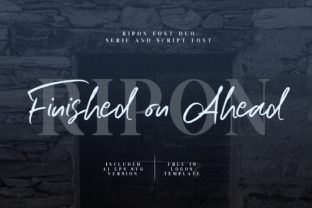
Ripon Duo: A Serif and Script Font Pair for Elegant Design Projects
Ripon Duo is a coordinated font family consisting of two complementary typefaces: a refined serif and an expressive script. Designed to work together harmoniously, the duo offers typographic contrast without visual conflict—making it a practical choice for designers seeking cohesion across varied design elements.
The serif face features clean lines, balanced proportions, and subtle calligraphic influences that lend readability and quiet sophistication. The script face balances fluidity with legibility, avoiding excessive flourishes that can hinder clarity at smaller sizes or in longer text blocks. Both fonts share consistent x-heights, weight relationships, and spacing logic—key technical considerations that support seamless pairing.
Why Designers Consider Ripon Duo
Designers often seek typeface combinations that simplify decision-making while delivering visual distinction. Ripon Duo addresses this by offering a pre-tested pairing rather than requiring manual adjustment of metrics, kerning, or contrast ratios. This reduces time spent on typographic refinement—especially valuable when working under tight deadlines or managing multiple branding assets.
Its intended use cases reflect common professional needs: wedding stationery, book covers, editorial layouts, brand identity systems, and social media graphics. These contexts benefit from clear hierarchy and emotional resonance—qualities supported by the interplay between the structured serif and the humanist script.
Practical Benefits and Realistic Expectations
One strength of Ripon Duo is its versatility within defined constraints. The serif works well for body text, captions, and headings where clarity and authority matter. The script serves effectively for short emphasis—names, titles, quotes, or decorative accents—without overwhelming surrounding content. Because both fonts are designed as a set, alignment, baseline consistency, and stylistic harmony are built-in, reducing trial-and-error during layout.
However, expectations should be grounded. The script is not intended for extended paragraphs or low-resolution digital displays. Its legibility diminishes below 18–20pt in most settings, particularly on mobile screens or in email clients with limited font support. Similarly, the serif lacks extensive optical sizing or variable axes—so users needing fine-grained typographic control (e.g., for responsive web typography) may find its range limited compared to more expansive families.
The included bonus—10 logo templates—provides starting points rather than finished solutions. These are editable vector files, useful for inspiration or rapid mockups, but require customization to match specific brand voice, color schemes, or layout requirements. They do not replace strategic logo development but can accelerate early-stage exploration.
Situations Where Ripon Duo Is a Strong Fit
Ripon Duo performs well in projects where aesthetic cohesion and moderate typographic complexity are priorities. For example:
- Wedding invitations and suites: The serif conveys formality and tradition; the script adds personal warmth—ideal for names, dates, and venue details.
- Book covers and interior chapter headings: The contrast supports genre cues—elegance for literary fiction, approachability for memoirs or self-help titles.
- Small-business branding: Cafés, boutiques, or creative studios may use the serif for taglines or contact info and the script for business names or slogans—creating instant recognition without overcomplication.
- Printed stationery and marketing collateral: Consistent letterforms across business cards, letterheads, and brochures help reinforce brand identity with minimal effort.
In each case, success depends less on the fonts themselves and more on how thoughtfully they’re applied—particularly regarding scale, spacing, and color contrast.
When Alternatives May Be More Appropriate
Ripon Duo is not optimized for every scenario. Consider alternatives if your project requires:
- Web-first implementation with variable font support: Ripon Duo is delivered as static OTF/TTF files—not variable fonts—so it won’t adapt dynamically to screen size, weight, or width via CSS. Projects prioritizing responsive typography may benefit more from variable serif/script pairings like Playfair Display + Great Vibes (with fallback strategies) or custom-built variable solutions.
- Multilingual or extended character coverage: Ripon Duo supports basic Latin scripts (including diacritics used in Western European languages), but lacks Cyrillic, Greek, or extended Vietnamese support. Global brands or publications targeting diverse audiences should verify glyph coverage before committing.
- Highly technical or data-driven interfaces: Dashboards, reports, or documentation benefit from monospaced or highly legible sans-serif systems. Ripon Duo’s stylistic intent doesn’t align with functional UI typography needs.
- Budget-conscious open-source options: If licensing cost is a constraint, free alternatives like Cinzel (serif) paired with Dancing Script (script) offer similar stylistic goals—though without the same level of integrated tuning.
Making an Informed Decision
Evaluating Ripon Duo begins with clarifying your project’s core requirements. Ask yourself:
- Is typographic harmony across two distinct styles a priority—or would a single versatile font suffice?
- Will the fonts be used primarily in print, high-resolution digital formats, or mixed environments?
- Do you need broad language support, variable axes, or extensive OpenType features (e.g., stylistic sets, contextual alternates)?
- How much time can you allocate to testing, spacing adjustments, and fallback planning?
If your answer emphasizes print-focused elegance, moderate digital use, and time efficiency—Ripon Duo offers a coherent, tested solution. If your needs lean toward technical flexibility, global reach, or strict budget limits, exploring alternatives becomes more relevant.
Testing is essential. Download or preview the fonts in your actual design environment—whether Adobe Creative Cloud, Figma, or a web prototype—and assess how they behave at intended sizes and weights. Pay attention to line height, letter spacing, and contrast against background colors. What looks balanced in a specimen may shift in context.
Finally, consider long-term maintainability. A font pair that simplifies initial execution should also support future iterations—such as adding social media banners or updating a website’s typography system. Ripon Duo’s focused scope makes it easy to learn and apply consistently, but its narrow specialization means it may not grow with complex, evolving brand systems.
In summary, Ripon Duo is a purpose-built tool—not a universal replacement. Its value lies in thoughtful application, not broad capability. When matched to appropriate goals, it delivers reliable elegance with minimal friction.