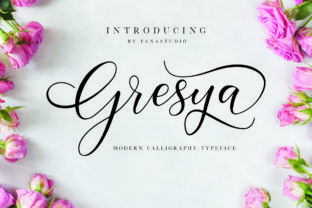
Gresya Script
Gresya Script is a stylish, feminine script font designed with intention—not just aesthetics. Its defining feature isn’t merely its elegance, but its expressive swashes: graceful, purposeful extensions that lend rhythm, personality, and visual hierarchy to typographic composition. Unlike decorative fonts that prioritize ornament over function, Gresya Script balances flourish with legibility, making it a strategic tool for professionals who need typography to support—not distract from—their message.
Why Typography Is a Strategic Choice, Not Just a Design Detail
Typography communicates before a single word is read. It signals tone, audience alignment, and brand maturity. When you choose Gresya Script, you’re not selecting a “pretty font”—you’re choosing a voice. That voice works best when it matches your objective: inviting warmth in a boutique skincare launch, conveying artisanal care in a handmade ceramics brand, or adding quiet confidence to a female-led coaching practice. The swashes aren’t decorative flourishes; they’re calibrated pauses—visual breaths that guide the eye and reinforce emotional pacing.
Where Gresya Script Delivers Real Value
Gresya Script excels where clarity meets character—and where the audience expects authenticity paired with polish. Consider these grounded use cases:
- Brand identity systems — Used selectively (e.g., logo lockup, hero headlines, or signature elements), Gresya Script anchors a brand’s feminine positioning without leaning into cliché. Its swashes add distinction without sacrificing scalability—especially when paired with a clean sans-serif for body text.
- Digital touchpoints with emotional weight — Email headers, landing page banners, or social media carousels benefit from its expressive energy. A well-placed swash on a headline like “You Belong Here” adds resonance—without needing extra copy.
- Printed collateral with tactile intention — Wedding invitations, boutique packaging, or workshop workbooks gain sophistication through Gresya Script’s organic flow. Its swashes translate beautifully to letterpress or foil stamping, reinforcing quality perception.
- Educational or creative offerings — For educators launching online courses on mindful living or freelancers selling digital planners, Gresya Script visually reinforces values like care, intuition, and personal growth—aligning design language with pedagogy or service ethos.
Using Swashes Intentionally—Not Automatically
The swashes in Gresya Script are powerful—but only when used with discipline. Defaulting to the most elaborate swash on every word undermines their impact. Instead, treat them like punctuation: deliberate, contextual, and sparing. Ask yourself:
- Does this swash serve a functional role—like guiding the reader’s eye from one key term to the next?
- Does it appear where attention should linger—such as the first letter of a headline or the final word in a tagline?
- Would removing it weaken the message’s emotional clarity—or simply make it quieter?
In practice, that means limiting swashes to one or two strategic points per composition. A business card might use a subtle entrance swash on the first initial of the owner’s name. A website banner may extend only the “G” in “Gresya” and the “S” in “Script”—creating visual bookends that frame meaning without overwhelming.
When Gresya Script Isn’t the Right Choice
Strategic typography means knowing when *not* to use a font as much as when to use it. Gresya Script loses effectiveness—and risks misalignment—when applied without context. Avoid it in:
- UI interfaces requiring speed and scannability — Navigation menus, form labels, or dashboard data tables demand neutrality and efficiency. Gresya Script’s expressive nature slows reading in high-cognition environments.
- Brands built on authority, technical precision, or institutional trust — Law firms, financial advisors, or medical practices may unintentionally undercut credibility if Gresya Script appears in core communication (e.g., terms of service or compliance disclosures).
- Multilingual or non-Latin deployments — While Gresya Script supports extended Latin characters, its swashes and spacing are optimized for English and Western European languages. Using it for Arabic, Devanagari, or CJK text compromises both aesthetics and functionality.
Pairing With Purpose—Not Just Contrast
How you pair Gresya Script matters more than how different the companion font looks. A common mistake is choosing a starkly geometric sans-serif “for contrast,” then letting the pairing feel transactional rather than harmonious. Instead, match by intent. If Gresya Script conveys warmth and approachability, pair it with a humanist sans-serif—like Poppins, Lato, or Sofia Pro—that shares similar x-height proportions and open counters. These fonts don’t shout “opposite”—they support continuity of voice.
Also consider weight distribution. Gresya Script’s light-medium base weight pairs best with medium or semi-bold companions—not ultra-thin or black weights—so neither element visually dominates without reason. Test hierarchy in real usage: set a headline in Gresya Script Light with swash, then body text in the same family’s companion sans at Regular—not Light or ExtraBold—unless testing confirms improved comprehension and retention.
Long-Term Brand Consistency Starts With Typographic Discipline
Using Gresya Script once is easy. Using it consistently across platforms, teams, and time is where strategy becomes operational. Document clear usage rules—not just “use Gresya Script for logos,” but “use Gresya Script Swash A for primary headlines; Swash B only for quoted testimonials; never apply swashes to body copy or button labels.” Include visual examples showing correct and incorrect spacing, kerning adjustments, and minimum size thresholds (e.g., “Swashes legible at 24px and above on web; 10pt and above in print”).
This level of specificity prevents drift. Without it, team members may interpret “feminine font” as permission to use Gresya Script everywhere—or worse, substitute similar-looking fonts that lack its refined spacing and swash logic. Consistency isn’t about rigidity; it’s about ensuring every appearance reinforces the same impression: considered, confident, and quietly distinctive.
Avoiding the “Aesthetic Trap”
The biggest risk with Gresya Script isn’t technical limitation—it’s using it as shorthand for “feminine” without aligning it to deeper goals. Choosing it because “it looks nice” or “my competitor uses something similar” invites surface-level branding. Instead, anchor the choice in outcomes: Does it help customers feel seen? Does it reduce cognitive load in emotionally charged messaging? Does it distinguish your offering in a crowded category where sameness prevails?
If the answer is vague—or rooted solely in preference—pause. Revisit your audience research, messaging pillars, and conversion pathways. Then ask: Would Gresya Script meaningfully improve comprehension, connection, or action in this specific context? If not, delay the decision. Typography serves people—not portfolios.
Practical Next Steps for Intentional Use
You don’t need to overhaul your entire system to begin using Gresya Script strategically. Start small, measure impact, and scale deliberately:
- Run a controlled test — Replace one static hero headline on your homepage with Gresya Script (using a single, intentional swash). Track time-on-page, scroll depth, and click-through rate on the adjacent CTA for two weeks versus the prior version.
- Build a micro-style guide — Define exactly three approved applications (e.g., “email subject lines under 50 characters,” “social post quote graphics,” “print brochure section dividers”) and share it with your designer or VA.
- Review existing assets — Audit your last six months of customer-facing visuals. Where does Gresya Script appear—and does each instance reflect a documented goal? Flag inconsistencies for refinement, not removal.
Gresya Script doesn’t guarantee results. But used with clarity of purpose, attention to context, and respect for audience cognition, it becomes more than a font—it becomes part of your operational vocabulary. It’s a reminder that even the smallest typographic choices carry weight when they’re made deliberately, evaluated honestly, and aligned to what matters most: helping the right people understand, trust, and act.