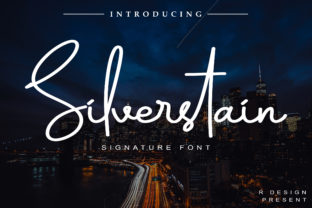
Silverstain: Handwritten Charm, Built for Real Work
If you’ve ever scrolled past a logo that felt warm but never cloying—or paused on a magazine cover where the headline seemed to lean in and speak directly to you—you’ve likely encountered the quiet power of a well-chosen script font. Silverstain isn’t just another decorative typeface. It’s a premium font with intention: fluid yet grounded, personal but polished, effortlessly expressive without sacrificing clarity.
Visually, Silverstain sits comfortably in the handwritten font category—but it avoids the pitfalls of many script fonts. There’s no excessive flourish or forced quirkiness. Its letterforms have subtle variation in stroke weight, natural entry and exit strokes, and gentle rhythm—like confident pen-on-paper writing, not calligraphy practice. It’s a display font by function (best at larger sizes), but its open counters and generous spacing give it surprising legibility even at 24–36pt in print or high-res digital use. It’s neither overly formal nor casually sloppy; it lands somewhere between a thoughtful note from a trusted colleague and the refined signature on a limited-edition product.
Where Silverstain Earns Its Place
This isn’t a font you drop into body text—and it shouldn’t be. Silverstain shines where personality matters most: in moments that define tone, signal authenticity, or invite connection. Think beyond “just a logo.” It works exceptionally well for boutique fashion labels (imagine it embossed on a garment tag or woven into a hangtag), editorial design for lifestyle or wellness magazines (a pull quote that breathes, not shouts), or packaging for small-batch skincare or artisanal food brands where craft and care are central to the story.
In digital spaces, Silverstain adds warmth to social media graphics—especially Instagram carousels or Pinterest quote pins—without looking dated or gimmicky. For web design, it’s ideal for hero section headlines, testimonial accents, or “About Us” subheads where human voice matters more than neutrality. Bloggers and content creators use it to highlight key takeaways or introduce personal essays. Crafters and hobbyists apply it to printable planners, greeting cards, or custom wedding stationery—not as filler, but as intentional punctuation.
What Silverstain Says—Without Saying a Word
Typeface choice is silent brand strategy. Silverstain signals approachability, attention to detail, and quiet confidence. It doesn’t scream “luxury” like a high-contrast serif might, nor does it default to “friendly startup” like many rounded sans serifs. Instead, it conveys sincerity and craftsmanship—qualities that resonate strongly with audiences aged 20–50 who increasingly value transparency and human-centered design.
Used consistently across touchpoints—a logo, email header, Instagram bio, and product label—it strengthens brand recognition through repetition of rhythm and gesture. That slight tilt in the ‘a’, the soft curve of the ‘g’, the way the ‘t’ crosses—these become visual signatures, reinforcing memory far more effectively than color alone. And because it’s inherently legible at appropriate sizes, it supports visual hierarchy without sacrificing warmth: your headline remains dominant, inviting, and easy to grasp in under two seconds.
Using Silverstain Well—Not Just Often
Start by asking: Is this moment meant to feel human? If the answer is yes—and the context allows for emphasis rather than utility—Silverstain is worth testing. Avoid using it for navigation menus, data tables, or legal disclaimers. Its strength lies in singularity, not scalability across every UI element.
When evaluating fit, consider contrast. Silverstain pairs naturally with clean, neutral typefaces: a sturdy geometric sans serif (like Montserrat or Inter) for supporting text, or a low-contrast serif (such as Lora or Merriweather) for editorial depth. The goal isn’t visual harmony at all costs—it’s complementary tension. Try setting a Silverstain headline over body copy in a highly readable sans serif. Notice how the script draws attention while the supporting type keeps things grounded and scannable.
Review what styles are included. Most quality releases of Silverstain include at least Regular and Bold weights, sometimes with alternate characters or ligatures. Check whether the set includes true italics (not just slanted versions) and whether punctuation feels balanced—not an afterthought. Test readability at your intended size and medium: print on uncoated stock versus screen on mobile requires different judgment calls. A 28pt Silverstain headline may pop beautifully on a poster but feel cramped in a 320px-wide Instagram Story.
Licensing, Legitimacy, and Long-Term Use
Silverstain is a commercial font—meaning it requires a proper license for business use. Free downloads or “unofficial” versions often lack critical features (OpenType support, language coverage, hinting for screens), contain malware, or violate terms that could expose your brand to legal risk. Reputable foundries or authorized platforms (like Creative Market, MyFonts, or the designer’s official site) provide clear licensing tiers: desktop-only, web font, app embedding, or extended licenses for merchandise or video use. If you’re building a brand identity system for a client, confirm their license covers redistribution—or purchase one that does.
Also check technical details before committing. Does the file support Unicode Latin Extended-A? Are there localized glyphs for accented characters used in French, Spanish, or German? If your audience spans multiple languages, these aren’t niceties—they’re necessities for professionalism and inclusion.
A Final Note on Restraint
The most effective uses of Silverstain share one trait: they don’t try to do too much. It’s not a font for shouting, competing, or overwhelming. It’s for leaning in. For signing off a newsletter with quiet confidence. For naming a handmade candle line. For turning a simple quote into something that lingers.
That’s the real value—not in how many projects it *can* go into, but in how meaningfully it elevates the ones where authenticity, warmth, and intention matter most. When used with purpose—not just because it looks “pretty”—Silverstain becomes part of the story, not just the decoration.