Skatter: A Two-Layer Modern Calligraphy Font for Distinctive Design
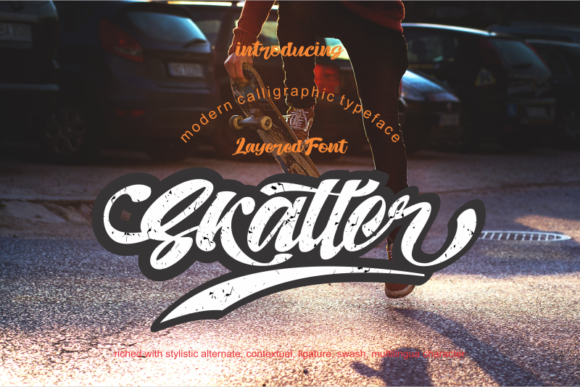
Skatter stands apart in the landscape of script and calligraphic typefaces—not through sheer novelty, but through a deliberate, functional duality. It’s a two-layer font: one layer captures fluid, expressive strokes with natural variation in weight and rhythm; the other adds subtle texture, shadow, or contrast—often used independently or combined to create depth. This layered architecture isn’t just visual flair; it’s a design tool that responds to context, hierarchy, and intent.
What Makes Skatter Structurally Different
Most modern calligraphy fonts simulate hand-drawn motion using OpenType features like contextual alternates or swashes—but they remain single-layer glyphs. Skatter departs from that convention by separating form and function across layers. The base layer delivers clean, rhythmic letterforms with organic entry and exit strokes. The second layer—whether a soft offset, a grainy overlay, or a contrasting stroke weight—introduces dimension without compromising legibility at medium to large sizes.
This separation allows designers to adjust visual impact without altering layout. For example, using only the base layer yields an elegant, minimalist script suitable for wedding stationery or boutique branding. Adding the second layer introduces tactile presence—ideal for posters, packaging, or digital banners where attention must be held amid visual noise.
Where Skatter Fits Among Contemporary Script Fonts
When evaluating script fonts for professional use, three broad categories emerge: highly formal (e.g., copperplate-inspired faces with strict baseline discipline), casual handwritten (loose, irregular, often optimized for informal contexts), and modern calligraphic—a middle ground balancing artistry with usability. Skatter belongs firmly in the third group, but its two-layer system gives it flexibility most peers lack.
Compared to single-layer alternatives, Skatter offers more control over tone and emphasis. A designer working on a sustainable skincare brand might use the base layer alone for product labels—clean, trustworthy, quietly refined. Later, for a seasonal campaign banner, they can activate the second layer to add warmth and craft—without switching fonts or redrawing layouts. That kind of consistency across touchpoints is rare among script fonts.
Practical Strengths—and Realistic Tradeoffs
Skatter excels where expressive typography needs to scale meaningfully: headlines, logotypes, invitations, editorial features, and social media graphics. Its rhythm supports readability in larger point sizes, and the layering helps maintain character even when scaled down slightly—say, in mobile app headers or small-format packaging. The design avoids excessive flourishes, so letters don’t collapse or blur at moderate resolutions.
However, those strengths come with boundaries. Skatter is not intended for body text. Its calligraphic nature and variable stroke weights reduce scanning efficiency below ~18pt. It also assumes a degree of typographic awareness: layer blending modes, color contrast, and spacing require thoughtful application. Using both layers with low-contrast colors—like light gray on off-white—can diminish clarity. Similarly, tight tracking may cause strokes to visually merge, especially in the textured layer.
Another consideration is language support. Skatter covers Latin-based scripts comprehensively—including extended diacritics and discretionary ligatures—but does not include Cyrillic, Greek, or CJK characters. Projects requiring multilingual branding beyond Western European languages will need supplemental typefaces.
Comparing Use Cases: When Skatter Adds Value vs. When It Doesn’t
Skatter shines in scenarios where differentiation matters, but authenticity and craft are expected. Consider these examples:
- A boutique coffee roaster uses Skatter’s base layer for its logo—refined yet approachable—and overlays the second layer selectively on seasonal bag designs to signal limited editions. The result feels intentional, not decorative.
- An independent publishing house applies Skatter to book cover titles, pairing it with a neutral sans-serif for subtitles and body copy. The layered contrast reinforces the imprint’s focus on artisanal production without overwhelming the content.
- A wellness studio chooses Skatter for workshop announcements and email headers, relying on its warmth and movement to reflect its values—while keeping class schedules and contact details in a highly legible, no-frills typeface.
In contrast, Skatter is less suited for interfaces requiring rapid information parsing—like dashboards, forms, or instructional diagrams. It also doesn’t replace the need for typographic hierarchy: using Skatter for every headline on a website dilutes its impact. And while its layers allow some customization, it doesn’t offer the granular stylistic controls found in variable fonts (e.g., adjustable weight, width, or slant). Designers needing fine-tuned optical scaling across dozens of sizes may find Skatter’s fixed-layer structure limiting.
Integration and Technical Considerations
Skatter is delivered as OpenType (.otf) files compatible with industry-standard applications—Adobe Creative Cloud, Affinity Suite, Figma (via desktop plugin), and modern web browsers via @font-face. Both layers are accessible as separate fonts, meaning no special software is required to use them individually. Some designers combine them manually in vector editors; others use layer-blending features in Photoshop or Illustrator for controlled opacity or color interaction.
For web use, performance remains manageable: each layer is under 150 KB when subsetted for common Latin characters. However, loading both layers increases HTTP requests and render time slightly—so teams optimizing for Core Web Vitals may choose to load only the base layer by default, adding the second layer conditionally (e.g., for hero sections only).
Skatter includes standard OpenType features—ligatures, stylistic sets, and positional numerals—but lacks advanced features like glyph substitution based on surrounding characters (contextual alternates). That means manual kerning adjustments may be needed for certain letter combinations, particularly in all-caps settings or tight headlines.
Making the Right Choice for Your Project
Selecting Skatter shouldn’t hinge on trendiness or aesthetic preference alone. Ask instead: Does this project benefit from typographic duality? If your goal is to reinforce brand voice across formats—where a logo must feel cohesive whether printed on kraft paper or animated on Instagram—Skatter’s layered logic supports that continuity. If you’re designing a high-volume newsletter where speed and scannability outweigh expressive nuance, a simpler, more constrained script—or even a well-chosen sans-serif—may serve better.
Also consider your team’s workflow. Skatter rewards intentionality: it works best when paired deliberately, not applied broadly. Teams comfortable adjusting layer opacity, testing contrast ratios, and refining spacing will extract more value than those treating it as a “drop-in” decorative font.
Finally, evaluate long-term fit. Skatter’s style sits comfortably between timeless and contemporary—it avoids extreme trends like exaggerated bounce or hyper-stylized terminals. That makes it adaptable across campaigns and years, provided usage remains considered. But like any expressive typeface, its effectiveness depends less on the font itself and more on how thoughtfully it’s deployed.
Final Perspective
Skatter isn’t a universal solution—but then few quality typefaces are. Its two-layer framework reflects a pragmatic understanding of modern design needs: the desire for personality, the necessity of clarity, and the reality of multi-environment delivery. It bridges the gap between purely artistic lettering and commercially viable typography—not by compromising either, but by giving designers calibrated tools to move between them.
If your work involves branding, editorial design, or experiential communication—and if you value type that carries intention without demanding constant adjustment—Skatter merits close evaluation. Just remember: its strength lies not in being everywhere, but in being exactly where it’s needed.