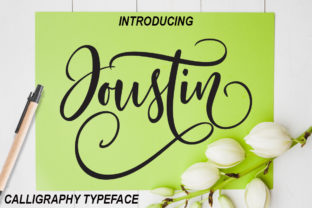
Joustin: A Classy Calligraphy Font for Purposeful Design
When you need typography that communicates refinement without sacrificing readability—or versatility—Joustin stands apart. It’s not just another script font. Joustin is a classy calligraphy font built with intention: elegant curves, balanced spacing, and subtle contrast that evoke craftsmanship rather than ornamentation. It doesn’t shout; it invites attention through quiet confidence. That makes it especially valuable for professionals who rely on visual communication to reinforce credibility, tone, and brand integrity.
Where Joustin Fits in Your Creative and Business Workflow
Joustin isn’t reserved for final touches alone. Its role shifts meaningfully depending on where it lands in your process—whether you’re sketching a concept, refining a pitch deck, or preparing client deliverables. Think of it as a consistent voice across stages: early ideation, mid-process iteration, and polished output.
In planning phases—say, when mapping out a rebrand or designing a course landing page—Joustin helps clarify intent before committing to layout. Using it in mood boards or style explorations signals a deliberate choice toward sophistication, not just decoration. That early alignment prevents mismatched tone later, especially when handing off to developers or printers who need typographic direction upfront.
During execution, Joustin works best where hierarchy and emotional resonance matter most: headlines, invitation headers, signature lines in email campaigns, or hero text in premium digital products. It’s less suited for body copy (due to its calligraphic nature), but that limitation is strategic—not a flaw. Knowing where *not* to use it is part of using it well.
Integration Across Tools and Platforms
Joustin is available in OpenType format, supporting standard ligatures and alternate characters—features that matter when consistency affects perception. Whether you’re working in Figma, Adobe Illustrator, or Canva, installing Joustin locally ensures access to its full character set. In web projects, embedding via @font-face or a trusted font service preserves fidelity across devices—just verify fallbacks (e.g., Georgia or Playfair Display) maintain similar weight and proportion if Joustin fails to load.
For marketers building email sequences, Joustin shines in image-based headers—not inline text—where rendering reliability is high and stylistic control is absolute. Similarly, educators creating printable worksheets or presentation slides benefit from Joustin’s legibility at larger sizes, especially when printed on matte or textured paper common in premium educational kits.
Compatibility extends beyond software. Joustin pairs cleanly with sans-serifs like Inter, Manrope, or Montserrat—fonts that ground its elegance with structure. Avoid pairing it with overly decorative scripts or condensed grotesques; contrast should support clarity, not compete for attention.
Practical Implementation Tips You’ll Use Immediately
- Start with purpose, not aesthetics. Ask: “Does this headline need warmth? Does this logo lockup require distinction?” If yes—and the context leans toward luxury, tradition, or personal craftsmanship—Joustin is likely appropriate.
- Test at real-world sizes. At 24px or smaller, Joustin’s fine strokes can blur on low-DPI screens. Reserve it for display sizes (36px and up) unless you’re using it in high-resolution print or SVG exports.
- Leverage OpenType features deliberately. Enable standard ligatures (
liga) for smoother word flow (“fi”, “fl”), and consider discretionary ligatures (dlig) only where they enhance rhythm—not distract. Turn them off in all-caps settings unless manually kerned. - Build reusable style tokens. In design systems, define Joustin as a “display” or “accent” font token—not a primary typeface. That keeps usage intentional and scalable across teams.
Consistency Without Compromise
Long-term use of Joustin depends less on novelty and more on discipline. Overusing any script font erodes impact. The goal isn’t to make everything “look fancy”—it’s to elevate moments that deserve emphasis. For freelancers managing multiple clients, maintaining a master typography guide (even a simple Notion doc or PDF) with approved Joustin use cases—“client welcome emails”, “certificate headers”, “book cover titles”—reduces decision fatigue and strengthens brand continuity.
Small business owners launching physical products—think artisanal candles, boutique stationery, or limited-run apparel—find Joustin especially effective on packaging and hang tags. Its tactile quality translates well to foil stamping and letterpress, bridging digital mockups with tangible production. Just confirm with your printer that the font’s thin strokes meet minimum line weight requirements (typically ≥0.25pt at 100% scale).
Workflow Integration Examples
A blogger launching a paid newsletter: They use Joustin for the banner image headline (“The Thoughtful Edit”) and the signature line beneath each issue. Body text remains in a highly readable serif (Charter) or sans-serif (Source Sans Pro). This creates visual rhythm: Joustin signals value and curation; the secondary font delivers substance.
An educator designing a certificate of completion: Joustin appears only in the recipient’s name and credential title (“Certificate of Mastery in Sustainable Design”). All other text—including date, instructor name, and institution—is set in a clean, neutral typeface. The result feels earned, not embellished.
A freelance designer preparing a brand identity presentation: They show Joustin alongside three pairing options—not as a standalone sample, but as part of a cohesive system. One slide demonstrates how Joustin + Inter handles a tagline, a quote block, and a CTA button label. That shows clients how elegance functions within function—not apart from it.
Quality Control and Long-Term Usability
Because Joustin is a single-weight, single-style font, scalability relies on smart layering—not font variations. To avoid monotony across touchpoints, pair it with a robust secondary family that offers optical sizing, variable axes, or extensive language support. Also, audit usage quarterly: does every instance still serve a clear communicative purpose? If Joustin appears in three places where one would suffice, simplify.
For publishers producing both digital and print editions, test Joustin’s rendering in PDF exports (especially with embedded subsets). Some PDF viewers compress glyphs unpredictably. Embedding the full font—not just used characters—prevents substitution glitches during handoff to editors or printers.
Finally, consider accessibility. While Joustin itself isn’t WCAG-compliant for body text, its use in large-format headings meets contrast requirements when paired with dark backgrounds or deep neutrals. Always validate foreground/background contrast ratios using tools like WebAIM’s Contrast Checker—especially if the headline appears over imagery.
Making Joustin Work for You—Not the Other Way Around
Joustin succeeds when treated as a tool with boundaries—not a solution looking for problems. It won’t fix weak messaging, compensate for poor layout, or substitute for thoughtful content strategy. But when aligned with intention, preparation, and context-aware implementation, it becomes a quiet force multiplier: reinforcing trust, distinguishing your work, and honoring the time your audience invests in engaging with it.
That’s why professionals return to Joustin—not for trendiness, but for reliability. It integrates cleanly into existing workflows because it asks little and delivers precisely what it promises: elegance with agency. Whether you’re refining a pitch, designing a wedding suite, or launching a micro-SaaS, Joustin earns its place by making the important things feel unmistakably significant.