Cherish Script: A Modern Script Font with Natural Elegance
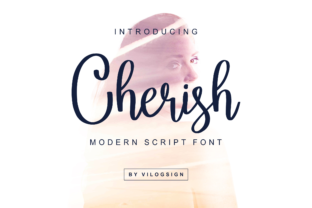
Cherish Script is a contemporary script typeface designed for visual clarity and expressive warmth. Unlike traditional calligraphic fonts that emphasize dramatic contrast or ornate flourishes, Cherish Script relies on softly rounded shapes, consistent stroke weight, and gentle rhythm to convey sophistication without formality. Its curves are intentional—not exaggerated—giving it a balanced presence across both digital and print applications.
What Sets Cherish Script Apart
The defining trait of Cherish Script lies in its approach to legibility and tone. Many modern scripts sacrifice readability for stylistic flair—tight spacing, overlapping letters, or extreme slant—but Cherish Script maintains open counters and generous letter spacing by default. This makes it more versatile than highly decorative alternatives when used at smaller sizes or in longer text blocks, such as magazine pull quotes or product packaging copy.
Its roundness isn’t just aesthetic; it contributes to perceived friendliness and approachability. Designers often describe this quality as “natural elegance”—a subtle blend of refinement and ease. That duality explains why Cherish Script works equally well for a boutique skincare brand seeking quiet luxury and a creative studio wanting warmth without whimsy.
Where Cherish Script Fits in Real-World Use Cases
Cherish Script shines in contexts where personality matters but professionalism remains essential. It’s frequently chosen for:
- Logos and branding systems — especially for lifestyle, wellness, hospitality, or artisanal businesses that want to signal care and authenticity;
- Editorial design — headlines and section titles in magazines or digital newsletters where tone supports narrative voice;
- Print collateral — wedding stationery, business cards, and posters where tactile quality and visual harmony are priorities;
- Digital interfaces — limited use in hero banners or feature headers, provided sufficient size and contrast are maintained.
It’s less suited for UI labels, data tables, or body text in long-form web content—areas where high legibility at small sizes and screen rendering consistency take precedence over stylistic nuance.
Comparing Cherish Script With Other Modern Script Options
When evaluating modern script fonts, designers often weigh three interrelated factors: expressiveness, versatility, and technical reliability. Cherish Script leans toward the middle of each spectrum—neither minimal nor maximal, neither ultra-narrow nor overly wide, neither strictly monoline nor dramatically contrasted.
Compared to bolder, higher-contrast scripts (e.g., those with pronounced thick-thin transitions), Cherish Script offers smoother scalability and better performance in color-separated print or low-resolution displays. Its even weight helps avoid ink spread issues on uncoated paper or subtle moiré effects in digital previews.
In contrast to ultra-light or delicate scripts—often favored for luxury fashion or fine art contexts—Cherish Script holds up more reliably in mixed-font layouts. Pairing it with a clean sans serif (like Inter, Poppins, or Montserrat) creates visual hierarchy without tension. Its moderate x-height and open forms prevent visual competition, unlike some narrower or tighter scripts that can feel cramped next to geometric typefaces.
Strengths and Practical Tradeoffs
One of Cherish Script’s notable strengths is its built-in cohesion. The lowercase and uppercase sets share proportional logic and rhythmic flow, so switching between cases feels intentional rather than disruptive. Ligatures and alternate characters are included thoughtfully—not as gimmicks, but as tools for fine-tuning spacing or adding subtle variation in headlines.
A practical tradeoff emerges in multilingual support. Like many independently designed display fonts, Cherish Script focuses first on English-language typography. Extended Latin characters (e.g., accented letters for French, Spanish, or German) are present, but coverage for Cyrillic, Greek, or non-Latin scripts is typically limited or absent. If your project targets broad international audiences—or requires consistent typographic treatment across multiple languages—you’ll need to verify character set completeness before committing.
Another consideration is licensing scope. Cherish Script is commonly offered under desktop and web font licenses, but usage rights for mobile apps, broadcast, or embedded systems vary by vendor. Always review license terms for your specific deployment context—especially if integrating into SaaS platforms or white-labeled products.
The Bonus Rose Flower Vector: Function Over Decoration
Included with many Cherish Script packages is a hand-drawn rose flower vector. Unlike generic clipart, this asset shares the same design ethos: soft curves, balanced proportions, and naturalistic detail without clutter. It’s not merely decorative—it’s modular and scalable, making it useful for creating custom dividers, watermarks, or integrated logo marks.
Designers report using the rose vector to reinforce brand themes (e.g., growth, care, organic process) without relying solely on typography. Because it’s delivered as a vector, it adapts cleanly to embroidery files, laser-cut templates, or responsive web graphics—extending Cherish Script’s utility beyond the page or screen.
When Cherish Script Is the Right Choice
Cherish Script fits best when your goal is to communicate intentionality and warmth without leaning into nostalgia or playfulness. Consider it if:
- You’re building a brand identity that values subtlety over loud differentiation;
- Your audience responds well to human-centered cues—soft edges, organic flow, restrained elegance;
- You need a script that pairs predictably with widely available system or web-safe sans serifs;
- You’re working across both print and digital touchpoints and require consistent rendering;
- You value thoughtful extras—like the rose vector—that integrate meaningfully into your visual system.
It also works well for iterative design processes. Because its structure is clear and its metrics forgiving, it’s easier to test variations—size, tracking, color, background contrast—without unexpected breakdowns in legibility or balance.
When You Might Look Elsewhere
Cherish Script may not be optimal if your project demands:
- Highly distinctive letterforms — for example, in competitive markets where immediate visual memorability outweighs tonal alignment;
- Extensive language support — particularly for right-to-left scripts or complex OpenType features like contextual alternates across large character sets;
- Ultra-flexible variable font capabilities — while Cherish Script offers stylistic alternates, it doesn’t currently exist as a variable font with adjustable weight, width, or slant axes;
- Strict accessibility compliance — though legible, its connected script nature means it shouldn’t serve as primary UI text or replace accessible heading fonts in WCAG-aligned interfaces.
In those cases, exploring alternatives—such as a carefully selected variable sans serif for flexibility, or a historically grounded script with broader language coverage—may better align with functional requirements.
Making an Informed Decision
Choosing a script font isn’t about finding the “most beautiful” option—it’s about matching typographic behavior to communication goals, audience expectations, and technical constraints. Cherish Script succeeds where tone, cohesion, and quiet confidence matter most. Its round shapes aren’t just stylistic choices; they’re functional decisions that support clarity, scalability, and emotional resonance.
If you’re comparing options, test Cherish Script alongside your top two alternatives in real layout scenarios—not just isolated words, but full headlines, paired type combinations, and exported PDF or PNG previews at actual size. Pay attention to how it behaves in your intended medium: Does it render crisply on screen? Does ink spread noticeably on your chosen paper stock? Does it retain personality at 14pt in a business card mockup?
That kind of hands-on evaluation—grounded in your specific context—is what separates informed selection from aesthetic guesswork. Cherish Script gives you room to explore that process with intention, not just inspiration.