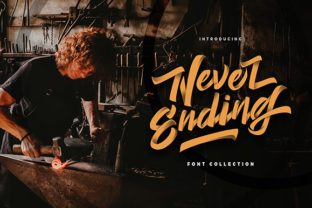
Never Ending: A Vintage Script Font with Real Personality
If you’ve ever held a well-worn letterpress poster, flipped through a 1940s recipe book, or admired the hand-lettered sign on a neighborhood bakery window—you know that certain fonts don’t just sit on the page. They breathe. Never Ending is one of those rare script fonts that feels both deliberately crafted and effortlessly human. It’s not a sterile digitized imitation of handwriting—it’s a premium font with genuine rhythm, subtle ink variation, and a relaxed confidence that comes from thoughtful design.
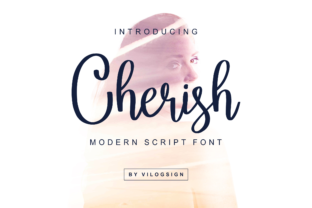
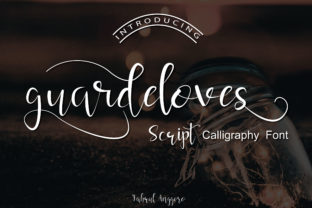
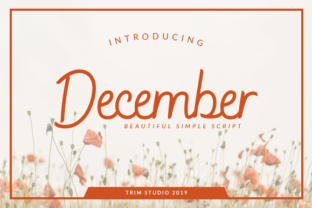
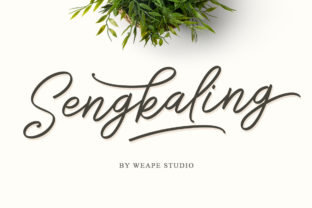
Visually, Never Ending sits comfortably between vintage charm and modern usability. Its strokes carry gentle tapering, soft entry and exit points, and slight irregularities that mimic real pen movement—no robotic uniformity here. The lowercase “g” has a looping tail; the “y” dips with quiet intention; capital letters balance flourish with restraint. It’s a script font, yes—but not overly ornate or difficult to read at medium sizes. That balance makes it unusually versatile for a display font: expressive enough for logos and posters, grounded enough for product labels or social media graphics.
Where Never Ending Fits Naturally (and Where It Doesn’t)
This isn’t a font for body text in long-form editorial design—or for tiny disclaimers on packaging. But within its sweet spot? It shines. Think t-shirt prints where authenticity matters more than precision. Business cards for a ceramicist, a small-batch coffee roaster, or an indie bookstore—places where warmth and craft are part of the brand identity. Posters for local music venues, farmers’ markets, or handmade goods fairs benefit from its approachable yet distinctive voice.
In logo design, Never Ending works especially well when paired with a clean, neutral sans serif (like Montserrat, Inter, or even a sturdy grotesque like Franklin Gothic). That contrast creates visual hierarchy without competing: the script carries personality, the sans grounds it in clarity. You’ll see this pairing used effectively on café signage, podcast cover art, and artisanal product packaging—where recognition and tone matter as much as legibility.
It also performs well digitally—when used intentionally. On Instagram posts or Pinterest pins, Never Ending adds texture and memorability without sacrificing scannability, especially at headline size (36px and up). Just avoid using it for buttons, navigation menus, or anywhere users need to parse information quickly. Web design demands functional typography first; Never Ending is best reserved for hero banners, quote overlays, or section dividers—not interface elements.
How It Shapes Perception—Without Saying a Word
Typefaces quietly shape how people feel about your work before they read a single word. Never Ending signals care, craft, and continuity—not flashiness or trend-chasing. That impression matters. A boutique skincare brand using Never Ending in its logo suggests attention to detail and natural ingredients, not clinical efficiency. A food blogger choosing it for their site banner implies recipes passed down, not algorithm-optimized meal prep.
That doesn’t mean it lacks professionalism. Far from it. What it lacks is sterility. In a landscape saturated with ultra-minimalist sans serifs and AI-generated visuals, Never Ending offers differentiation rooted in human gesture—not novelty for novelty’s sake. When used consistently across touchpoints (business card, website banner, product tag), it strengthens brand recognition by reinforcing a singular, coherent mood.
But consistency only works if readability stays intact. Test it early: print a mock-up of your business card at actual size. View your social graphic on a phone screen—not just your desktop monitor. Does the “r” and “n” still distinguish themselves? Does the flow hold up in all-caps usage? These aren’t theoretical questions—they’re practical checkpoints that keep your design grounded.
Practical Tips Before You License It
Never Ending is a commercial font, meaning you’ll need an appropriate license for any public-facing or revenue-generating use. Most reputable foundries offer straightforward licensing tiers—personal, small business, and extended (for unlimited distribution, like digital templates or merchandise). Read the license terms carefully: some restrict web embedding or require additional fees for e-commerce use. If you're designing for a client, clarify who holds the license—your studio or theirs—before delivery.
The font family typically includes one weight (regular) with standard OpenType features: ligatures, stylistic alternates, and swashes. Don’t enable every flourish at once. A single swash on the first letter of a headline can elevate; applying them throughout often dilutes impact. Try toggling alternates in your design app—sometimes the “a” or “e” alternate reads more clearly in tight spaces.
Pairing matters. Avoid other script fonts nearby—they’ll compete. Steer clear of overly decorative serifs too; they’ll clash tonally. Instead, lean into contrast: a sturdy geometric sans for subheads, a warm text face like Lora or Merriweather for longer copy. For packaging design, consider how Never Ending interacts with photography—its organic lines soften sharp product shots, while its rhythm echoes natural textures like linen, wood grain, or watercolor paper.
A Few Real-World Observations
- A Portland-based candle maker uses Never Ending for jar labels alongside a muted palette and soy wax photography—the font’s soft edges mirror the tactile quality of their product.
- An independent newsletter on slow living pairs Never Ending headlines with a modest serif (Crimson Text) for body copy—creating visual breathing room and reinforcing editorial warmth.
- A Brooklyn florist applied Never Ending to a large-scale mural on their shop wall, then repeated the same phrase (“Seasonal. Local. Thoughtful.”) in smaller form on thank-you cards—building cohesion without repetition fatigue.
None of these uses force the font into roles it wasn’t built for. They respect its nature: a display font with personality, not a utility tool. That restraint is what makes Never Ending feel timeless rather than trendy—and why it remains a go-to for designers who prioritize resonance over replication.