Clawster: Where Raw Script Meets Real-World Readability
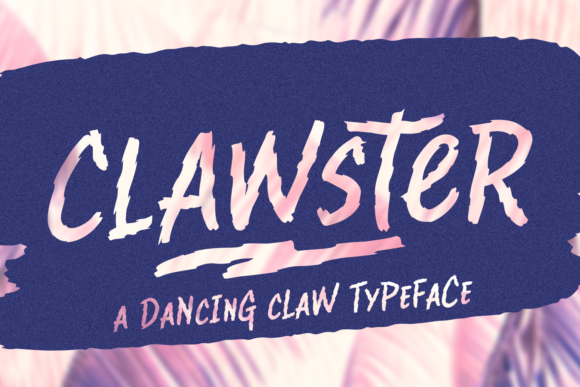
Typography isn’t just about choosing a font—it’s about choosing a voice. And in a digital landscape saturated with polished, over-refined scripts and sterile sans-serifs, Clawster stands out by doing something quietly radical: it embraces rawness without sacrificing clarity. It’s not a decorative flourish meant for one-off headlines. It’s a script font built with intention—its letters retain the organic energy of hand-drawn forms, yet each character is carefully shaped for legibility across sizes, devices, and contexts. That balance—between expressive personality and functional reliability—is why designers, marketers, educators, and small business owners are turning to Clawster not as a novelty, but as a practical tool.
Why “Raw” Doesn’t Mean “Unrefined”
“Raw” is often misunderstood in typography. It doesn’t mean unfinished, inconsistent, or hard to read. With Clawster, “raw” refers to authenticity—the visible trace of human gesture in the stroke weight, the subtle asymmetry in letterforms, the intentional imperfection that signals warmth and approachability. Unlike many script fonts that collapse into illegibility below 24pt or blur on mobile screens, Clawster’s spacing, x-height, and contrast have been calibrated for real use. Its lowercase a and g remain distinct. Its connecting strokes avoid visual clutter. Even at 16px in a web interface or email signature, it retains character—without demanding squinting or zooming.
This matters because user expectations have shifted. People no longer tolerate beautiful-but-unusable type. They expect interfaces to feel personal *and* performant. A café owner adding Clawster to their Instagram bio isn’t just chasing aesthetic appeal—they’re signaling craft, care, and local authenticity. A freelance educator using it in a workshop handout isn’t prioritizing flair over function; they’re making learning materials feel inviting *while* ensuring students can scan key points quickly.
From Niche Tool to Cross-Disciplinary Asset
Clawster didn’t emerge in a vacuum. It reflects broader changes in how professionals approach branding and communication. Five years ago, many businesses defaulted to safe, corporate fonts—even for creative ventures. Today, differentiation is harder, attention spans shorter, and trust more fragile. Consumers increasingly favor brands that feel human, not homogenized. That’s pushed designers, founders, and content creators toward typefaces that carry narrative weight without needing explanation.
Clawster fits naturally into this shift—not as a replacement for system fonts in body text, but as a strategic accent. It works where personality needs to land: logos for boutique studios, headings in course landing pages, quotes in newsletters, packaging for handmade goods, even slide titles in investor pitches. Its strength lies in restraint: used once per layout, it adds distinction; overused, it dilutes impact. That discipline aligns with modern design thinking—where every element earns its place.
How Real Users Are Applying Clawster Today
- A sustainable skincare brand uses Clawster for product names on labels and website banners—pairing it with a clean, neutral sans-serif for ingredients and descriptions. The contrast reinforces their dual values: artisanal care and scientific transparency.
- An independent language tutor incorporates Clawster into weekly PDF worksheets—not for paragraphs, but for section headers like “Your Daily Practice” or “Let’s Reflect.” Students report the material feels less formal, more encouraging.
- A freelance UX writer selects Clawster for client presentation covers, then switches to a highly legible variable font for body copy. The result? A first impression that conveys empathy and creativity, backed by clear, scannable content.
- A community garden initiative applies Clawster to event posters and volunteer sign-up sheets. Its warmth helps soften bureaucratic language (“Permit Required”) and invites participation from diverse age groups.
What ties these examples together isn’t stylistic uniformity—it’s purposeful contrast. Clawster isn’t competing with Helvetica or Inter. It’s complementing them. Its role is relational: to signal intention, not replace utility.
Workflow Integration—Not Just Aesthetic Add-On
Adopting a new font used to mean wrestling with licensing, file formats, and rendering inconsistencies. Today, Clawster integrates smoothly into common tools: Figma, Adobe Creative Cloud, Google Fonts (where available), and modern CSS via @font-face. Its OpenType features include standard ligatures and contextual alternates—subtle refinements that improve rhythm in longer words, without requiring manual intervention. For developers, it loads efficiently; for designers, it scales predictably.
That technical ease supports a larger trend: the blurring of roles. A solopreneur managing their own site may not be a typographer—but they *are* responsible for how their message lands. Clawster lowers the barrier between concept and execution. You don’t need advanced knowledge of kerning pairs to use it well. You do need to understand hierarchy—and that’s a skill more widely accessible than font engineering.
Readability as a Value, Not an Afterthought
Many script fonts ask users to work harder—to decode, pause, re-read. Clawster asks only for attention, not effort. Its readability stems from deliberate choices: generous counters (the enclosed spaces inside e, a, o), consistent baseline alignment, and restrained flourishes that don’t interfere with adjacent characters. This isn’t accidental. It reflects growing awareness—among designers, accessibility advocates, and platform developers—that legibility is foundational to inclusion.
Consider a blog post shared across LinkedIn, email, and a personal site. If the headline uses a script font that renders poorly on Android or fails contrast checks, part of your audience disengages before reading the first sentence. Clawster avoids those pitfalls. It meets WCAG contrast guidelines when paired with appropriate background colors. It remains distinguishable for readers with mild dyslexia or visual fatigue. That’s not “bonus functionality”—it’s responsible design.
Practical Tips for Getting Started
- Start small. Try Clawster in one high-impact spot: your logo lockup, a hero-section headline, or a call-to-action button. Observe how it changes tone—not just appearance.
- Pair intentionally. Combine it with a highly legible sans-serif (e.g., Inter, Lato, or even system fonts like -apple-system) for body text. Avoid other scripts or overly decorative fonts nearby.
- Test across contexts. View it on mobile, in dark mode, printed on uncoated paper, and at 120% browser zoom. Does it retain character *and* clarity?
- Respect hierarchy. Use size, weight, and spacing—not just font choice—to guide the eye. Clawster shines when it has room to breathe.
- License responsibly. Verify usage rights for your context—web, app, merchandise, or print. Most reputable vendors offer clear, tiered options for individuals and teams.
Clawster won’t solve branding challenges alone. But it does offer something increasingly rare: a script font that respects both the designer’s intent and the reader’s time. It doesn’t shout. It leans in. In an era where authenticity is earned—not assumed—its quiet confidence resonates. Whether you’re launching a podcast, redesigning a school newsletter, or building a Shopify store, Clawster invites you to communicate with presence, not just polish.
Its relevance isn’t tied to a passing trend. It’s rooted in a lasting need: to connect with clarity, express with honesty, and design with empathy—all without compromising on craft.