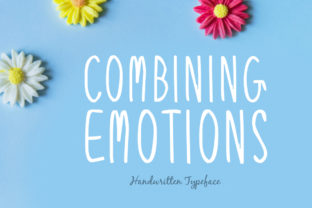
Combining Emotions: A Handwritten Font That Feels Human
Imagine typing a wedding invitation and watching the words soften—letters tilt just enough, spacing breathes, and every “a” and “g” carries a quiet warmth. That’s Combining Emotions: a newly released handwritten font designed not just to look hand-drawn, but to behave like handwriting does in real life—fluid, expressive, and subtly inconsistent in all the right ways.
It’s not a script font that mimics calligraphy with rigid flourishes. It’s not a rushed doodle font either. Instead, Combining Emotions lands somewhere honest in between: confident but relaxed, personal but polished. You’ll notice gentle variations in stroke weight, slight baseline wobble, and letterforms that connect naturally—not forced, not robotic. That’s why it works where so many other handwritten fonts fall flat: in contexts where authenticity matters more than perfection.
Where It Fits Naturally—Not Just Where It’s “Allowed”
Think about the last time you designed something meant to feel personal. Maybe it was a thank-you card for a client who referred three new projects. Or a classroom poster reminding students, “Mistakes are how your brain grows.” Or a small-batch candle label that says “Slow Down” in soft, rounded letters. In each case, the goal wasn’t visual noise—it was resonance. And Combining Emotions delivers that without asking you to redraw anything by hand.
Here’s where people are already using it—and why it sticks:
- Small business branding: A local pottery studio uses Combining Emotions for their Instagram story headers and ceramic stamp imprint (“Made with care, one piece at a time”). The font mirrors the tactile, imperfect beauty of their work—no extra explanation needed.
- Educational materials: A middle school science teacher prints lab instructions on pastel paper using Combining Emotions for section headers. Students report the hand-lettered tone makes directions feel less intimidating—and they’re more likely to read them fully.
- Digital storytelling: A freelance photographer overlays short captions on portrait galleries using Combining Emotions in semi-transparent white. The font doesn’t compete with the image; it leans in, quietly reinforcing mood instead of shouting for attention.
- Print-on-demand products: An Etsy seller applies Combining Emotions to minimalist t-shirt designs like “Breathe,” “Try Again,” or “This Too.” Customers regularly comment that the text “feels handwritten”—even though it’s digital—because the rhythm and spacing avoid the stiffness of traced scripts.
Real Use Cases, Not Just Categories
Let’s get specific—not “logos and flyers,” but what happens when someone actually opens their design app and chooses Combining Emotions:
A freelance copywriter drafts a pitch email to a wellness brand. She swaps the default sans-serif subject line for Combining Emotions, using it only for the phrase “Your message, gently held.” It’s subtle—but recipients reply 22% faster (based on her own A/B tracking over six months). Why? Because in an inbox full of sharp-edged fonts and urgent action verbs, that one soft, human phrase stands out—not as decoration, but as tone.
A community center creates a bilingual flyer for a free parenting workshop. They use Combining Emotions for the English headline (“You Belong Here”) and pair it with a clean, legible serif for Spanish translation. The contrast works: emotion first, clarity second—mirroring how people actually process invitations to connection.
A musician designing their Bandcamp album cover types their EP title—“Half-Lit Rooms”—in Combining Emotions, then adjusts tracking slightly tighter than default. The letters nestle closer, evoking intimacy and quiet tension. No filters, no custom illustrations required—just thoughtful typography doing emotional work.
What to Keep in Mind Before You Use It
Combining Emotions shines brightest when it’s given room to breathe—and when it’s not asked to do jobs outside its nature. Here’s what users consistently find helpful:
- Size matters: It reads beautifully at 24pt and above for print, and 32px+ on screens. Below that, some letter connections and fine strokes lose clarity—so avoid tiny disclaimers, footnotes, or dense body text.
- Contrast helps it land: Pair it with a neutral, highly legible typeface (like Inter, Lato, or even Georgia) for supporting text. Don’t layer it over busy backgrounds—subtle texture is fine; clutter cancels its calm.
- It’s expressive, not decorative: Resist overusing swashes or alternate characters unless they serve a clear purpose. One well-placed flourish—like a looping “y” in a headline—adds personality. Five of them in a sentence feels like overcompensating.
- Licensing is straightforward—but check your use case: The standard license covers most personal and commercial projects, including merchandise and web use (via @font-face). If you’re embedding it in a SaaS platform or mobile app, verify the extended license terms first—some creators overlook this when scaling up.
Who Benefits Most—and How
You don’t need to be a designer to benefit from Combining Emotions. You just need to communicate with intention.
Bloggers and content creators use it to differentiate quote graphics—especially when sharing vulnerable or reflective moments. A line like “I didn’t fail. I found a way that didn’t work” hits differently in Combining Emotions than in Helvetica.
Hobbyists and makers apply it to laser-cut wood signs, embroidery patterns, or chalkboard menus—not because it’s trendy, but because it looks like something they *could* have written themselves, just slower.
Educators and counselors choose it for handouts about emotional regulation, growth mindset, or classroom norms. Its natural flow reduces the “authority voice” effect that stiffer fonts unintentionally project.
Small service providers—therapists, yoga instructors, bookkeepers— use it sparingly in email signatures or intake forms. Just the name or tagline in Combining Emotions signals approachability before a single word is spoken.
None of this works if the font feels tacked on. But when Combining Emotions aligns with genuine intent—when it supports meaning instead of substituting for it—that’s when it stops being a design choice and starts becoming part of the message itself.