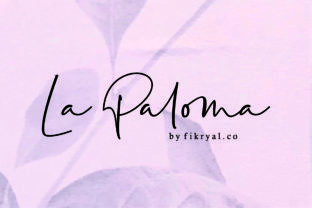
La Paloma: The Handwritten Font That Feels Like a Signature
There’s something instantly human about handwriting — the subtle variations in pressure, the gentle slant, the rhythm of connected letters. La Paloma captures that authenticity with remarkable fidelity. It’s not just another script font; it’s a carefully crafted, expressive handwritten typeface designed to evoke warmth, personality, and trust. Whether you're sketching a logo concept at 2 a.m. or finalizing a boutique business card, La Paloma brings a grounded, approachable energy to your designs.
What Makes La Paloma Stand Out?
Unlike many decorative scripts that rely on exaggerated flourishes or rigid symmetry, La Paloma balances natural flow with clean legibility. Its letterforms feature soft terminals, consistent yet organic stroke contrast, and graceful connections — especially in its cursive variants — that mimic real pen-on-paper movement. Every character feels intentional, not algorithmic.
Key characteristics include:
- True handwritten rhythm: Letters vary slightly in height and angle, avoiding robotic uniformity.
- Open counters and generous spacing: Ensures readability even at smaller sizes (e.g., on business cards or app interfaces).
- Multiple weights and styles: Includes regular, bold, and alternate characters — giving designers flexibility without sacrificing cohesion.
- Cross-platform compatibility: Works seamlessly in design tools like Adobe Creative Suite, Figma, Canva, and web environments via modern font embedding.
Importantly, La Paloma doesn’t try to be everything. It’s not a display font meant for giant billboards alone, nor is it a neutral sans-serif for corporate reports. Its sweet spot lies where authenticity meets utility — where your audience needs to feel seen, not sold to.
Where Does La Paloma Shine? Real-World Uses
The versatility of La Paloma becomes clear when you look at how people actually use it — not in theory, but in practice.
Logos & Brand Identity
Small businesses — from ceramic studios to indie bakeries — often choose La Paloma for wordmarks because it communicates craft, care, and individuality. A café named “Hearth & Honey” might pair La Paloma with a simple serif for body text, creating visual harmony between handmade goods and thoughtful typography.
Printed Materials
Posters, flyers, and event invitations gain immediate charm with La Paloma. Its natural flow guides the eye without overwhelming content. For example, a local yoga studio’s seasonal retreat poster uses La Paloma for the headline (“Breathe Deeply, Begin Again”) — evoking calm and intention before the reader even processes the details.
Digital Mock-Ups & Social Content
Designers building product mock-ups — think mugs, tote bags, or stationery — frequently layer La Paloma over realistic textures. Its adaptability means it looks equally convincing on matte paper or glossy enamel pins. On Instagram, food bloggers use it for recipe titles overlaid on flat-lay photos; the font adds tactile warmth that complements natural lighting and raw ingredients.
Editorial & Publishing
In magazines and zines, La Paloma appears in pull quotes, section headers, or hand-lettered captions. Because it’s highly legible at 14–18pt, editors can use it to break up dense text blocks while preserving tone — especially in lifestyle, wellness, or creative nonfiction features.
Who Benefits Most From Using La Paloma?
You don’t need to be a professional designer to get value from La Paloma. In fact, its greatest strength may be accessibility:
- Small business owners who handle their own branding — whether updating a Canva menu or designing a Shopify banner — find La Paloma intuitive and impactful without requiring advanced typography knowledge.
- Teachers and educators use it for classroom posters, award certificates, or welcome signs — reinforcing a nurturing, personal learning environment.
- Content creators (podcasters, newsletter writers, Etsy sellers) lean on La Paloma to unify visual assets across platforms, helping audiences recognize their voice at a glance.
- Students and hobbyists appreciate its friendly learning curve: it’s easy to test, pair, and iterate with — no steep technical barriers.
Strengths — And Honest Considerations
No font is universally perfect — and acknowledging that builds trust. Here’s what users consistently praise about La Paloma, alongside practical notes for informed decisions:
Strengths
- Emotional resonance: Builds instant connection — ideal for brands centered on empathy, creativity, or community.
- Easy pairing: Combines effortlessly with clean sans-serifs (like Inter or Montserrat) or warm serifs (such as Lora or Playfair Display).
- Web-ready performance: Lightweight file size and WOFF2 support mean fast loading — critical for SEO and user experience.
Considerations
- Not ideal for long paragraphs: Like most script fonts, La Paloma works best for short, high-impact text — headlines, quotes, labels — rather than body copy.
- Limited language support: While it covers Latin-based languages (English, Spanish, French, Portuguese, etc.), it doesn’t include extended Cyrillic, Greek, or Asian character sets.
- Context matters: A law firm’s official letterhead might feel misaligned with La Paloma’s casual elegance — whereas its sister brand’s pro bono workshop flyer would benefit greatly.
Evaluating If La Paloma Fits Your Project
Before downloading or licensing, ask yourself three simple questions:
- What emotion do I want this piece to convey? If “friendly,” “thoughtful,” “artisanal,” or “inviting” top your list, La Paloma is likely a strong candidate.
- How much text will use this font? If more than two lines appear together — especially in small sizes — preview it in your actual layout. Test readability on both desktop and mobile screens.
- Does it reflect who I am — or who my audience is? A children’s book illustrator using La Paloma for chapter titles reinforces playfulness. A fintech startup using it for dashboard labels may unintentionally undermine credibility.
When in doubt, start small: apply La Paloma to one element — a call-to-action button, a testimonial quote, or an email subject line — and gather feedback. Real-world response beats theoretical preference every time.
Final Thought: Typography With Intention
Fonts are never neutral. They carry weight, history, and subtext. La Paloma doesn’t shout — it leans in. It doesn’t dazzle with complexity — it disarms with sincerity. That’s why it endures across industries and devices: because it serves people first, not trends.
Whether you’re launching your first online shop or refining a decade-old brand voice, choosing La Paloma signals that you value clarity, humanity, and quiet confidence in your communication. And in a world saturated with noise, that kind of intentionality isn’t just noticeable — it’s memorable.
Explore how La Paloma performs in your next project, and remember: great typography doesn’t distract — it deepens understanding, one genuine letter at a time.