Dino Prints Font Overview and Evaluation
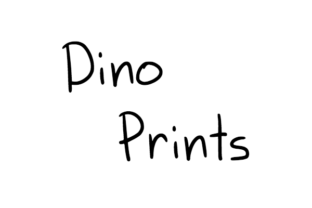
Dino Prints is a playful, handwriting-style typeface designed to evoke spontaneity and youthful energy. It features irregular baseline alignment, variable stroke widths, and slightly uneven letterforms—hallmarks of authentic pen-on-paper writing. Unlike highly polished script fonts, Dino Prints embraces subtle imperfections: some characters include slight wobbles, tapered terminals, or gentle overlaps that reinforce its hand-drawn character. It is not a calligraphic or formal script; rather, it sits comfortably between casual sketching and expressive comic lettering.
People often seek out Dino Prints when they need typography that feels personal, approachable, and unpolished—without veering into illegibility or visual clutter. Its primary appeal lies in projects where tone matters as much as function: children’s book illustrations, indie comic dialogue bubbles, educational posters, sticker designs, or branding for youth-oriented products. Because it mimics natural handwriting, it can help soften digital interfaces or add warmth to otherwise sterile layouts.
When Dino Prints Fits Well
Dino Prints performs best in contexts where legibility at moderate sizes is sufficient and stylistic authenticity outweighs strict typographic consistency. For example:
- Comic book speech balloons: Its energetic rhythm supports expressive voice without competing with artwork.
- Printed educational materials for early learners: The informal shape reinforces familiarity and reduces cognitive load for beginning readers.
- Handmade-style product packaging: Especially for craft-based or eco-conscious brands aiming for artisanal credibility.
- Social media graphics targeting younger audiences: Where personality and immediacy are more valuable than formal polish.
In these cases, the font’s intentional irregularities become assets—not flaws. Designers who value expressive typography over rigid grid alignment often find Dino Prints a reliable tool for injecting informality and charm.
Key Considerations and Tradeoffs
Like any display or handwriting-style font, Dino Prints comes with practical constraints. Its most notable limitation is reduced readability at small sizes or in long-form text. Letters such as “a,” “g,” and “s” use simplified, non-standard shapes that may slow recognition in dense paragraphs. As a result, it is unsuitable for body copy, legal disclaimers, data tables, or accessibility-critical interfaces.
Another consideration is language support. Dino Prints typically includes Latin-based characters (A–Z, a–z, numerals, basic punctuation), but extended diacritics, Cyrillic, or CJK glyphs are generally absent. Users working with multilingual content should verify glyph coverage before committing to the font across international campaigns.
Technical integration is straightforward—it’s available in standard OpenType (.otf) and TrueType (.ttf) formats—but variable font features (e.g., weight or width axes) are not part of its design. That means users cannot adjust stroke thickness or condensation dynamically. What you see is what you get: one weight, one width, one style.
Comparing Alternatives
Designers evaluating Dino Prints should consider how it stacks up against similar options. For instance:
- Bangers offers bolder, more uniform impact—better for headlines needing high contrast and strong presence, but less suited to delicate illustration work.
- Comic Neue provides improved readability over classic Comic Sans while retaining a friendly, accessible tone—ideal when clarity must coexist with informality.
- KG Primary Penmanship emphasizes structured learning-friendly forms, making it stronger for classroom worksheets where letter formation consistency matters.
- Amatic SC delivers a smoother, more even handwritten aesthetic—less “sketchy” than Dino Prints, and therefore better for branding requiring subtlety over exuberance.
The choice among these depends less on objective quality and more on alignment with project goals. If your priority is evoking unrehearsed creativity—think doodle-filled margins or impromptu notes—Dino Prints stands out. But if you need broader language support, tighter spacing control, or better screen rendering at 14px and below, alternatives merit closer review.
Practical Decision-Making Guidance
Before selecting Dino Prints, ask yourself three questions:
- What is the dominant size and context of use? If most applications fall between 24–60pt in print or high-resolution displays—and rarely drop below 18pt—it’s likely viable. If smaller sizes or responsive web text are involved, test thoroughly or look elsewhere.
- How much visual noise can the layout tolerate? Dino Prints adds texture. Pair it with clean, generous whitespace and minimal competing elements. Overly busy backgrounds or tightly packed layouts will diminish its effect and harm legibility.
- Does the project benefit from perceived authenticity? Handwriting fonts signal human effort and intentionality. If your audience values craftsmanship, playfulness, or approachability—especially in contrast to corporate or technical environments—Dino Prints supports that message. If neutrality or authority is required, it may undermine your intent.
Also keep licensing in mind. While many versions of Dino Prints are freely available for personal use, commercial deployment often requires a license. Always check the source—whether from Google Fonts, Adobe Fonts, or an independent foundry—for permitted usage terms, especially for client work or merchandise.
Final Thoughts
Dino Prints is not a universal solution, nor is it intended to be. Its strength lies in specificity: it excels where expressive, low-fidelity handwriting enhances communication rather than hinders it. It works well when paired with thoughtful hierarchy—using a neutral sans-serif for supporting text, for example—or when applied selectively to highlight moments of voice or personality.
For designers weighing options, the decision isn’t about whether Dino Prints is “good,” but whether its particular blend of irregularity, energy, and simplicity matches the communicative goal. When used deliberately—with awareness of its limits and strengths—it remains a distinctive, effective tool in the typographic toolkit.