Happy Birthday: A Playful, Practical Font
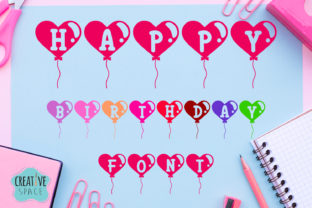
Happy Birthday isn’t just a phrase—it’s a friendly, instantly recognizable font designed with joyful clarity in mind. Its charm lies in its thoughtful simplicity: every capital letter matches its lowercase counterpart in shape and proportion. No stylistic hierarchy, no forced distinction—just consistent, approachable letterforms that feel handmade but remain highly legible.
This uniformity makes Happy Birthday unusually versatile. Designers reach for it when they want warmth without whimsy, playfulness without clutter. It doesn’t shout; it smiles. And because it avoids visual contradiction between cases, it streamlines layout decisions—especially valuable when time is tight or consistency across platforms matters.
Why Consistency Between Cases Matters
In real-world design work, mismatched capitals and lowercase letters often create unintended friction. A headline set in all caps might look energetic, but switching to sentence case mid-layout can break rhythm—or worse, confuse hierarchy. With Happy Birthday, you avoid that cognitive hiccup entirely. Whether you’re labeling a classroom poster, drafting an Instagram story, or typesetting a small-batch greeting card, the letterforms behave predictably.
This isn’t about rigid rules—it’s about reducing decision fatigue. When your font “just works” across cases, you spend less time adjusting tracking, scaling, or kerning—and more time refining message, color, or spacing. That’s practical efficiency designers and marketers feel in their workflow.
Creative Uses Across Real Projects
Here’s where Happy Birthday shines—not as a novelty, but as a functional tool:
- Small business signage: A café owner uses Happy Birthday for chalkboard-style menu headers. The even weight and open shapes hold up well at arm’s length—and the case consistency means “OPEN DAILY” and “Try our lavender latte” share the same friendly tone.
- Educational materials: An elementary teacher prints flashcards with sight words. Because uppercase and lowercase forms are identical, students focus on word recognition—not letterform differences—supporting early literacy without distraction.
- Digital content: A freelance blogger uses Happy Birthday for section dividers in email newsletters. Its gentle curves soften dense text blocks, while its readability ensures mobile users don’t zoom or squint—even at 14px.
- Print-on-demand products: A hobbyist creating custom stickers sets short phrases like “you’re awesome” and “happy day!” in the same font. The unified style creates cohesion across multiple designs, reinforcing brand voice without needing custom lettering each time.
Adapting for Audience and Platform
How you use Happy Birthday changes depending on who’s seeing it—and where.
For educators and nonprofits, pairing it with clean sans-serifs (like Inter or Open Sans) creates accessible, inclusive layouts. Use it for callouts, activity titles, or encouragement banners—never for long paragraphs. Its strength is emphasis, not endurance.
Marketers and small business owners benefit most when using it selectively: on social media graphics where attention spans are short, or on packaging where emotional resonance matters more than typographic complexity. Try it over muted backgrounds with generous whitespace—its friendliness amplifies when given room to breathe.
Freelancers and creators building digital assets (Canva templates, Notion dashboards, printable planners) find Happy Birthday especially useful for user-facing labels—“Add Note,” “Complete Task,” “Celebrate Win.” Because the letters feel familiar and non-intimidating, users engage faster and with less hesitation.
Styling Tips That Keep It Effective
Happy Birthday invites creativity—but staying effective means honoring its nature. Here’s how:
- Respect its scale: It performs best between 16px–48px on screen and 18pt–72pt in print. Smaller sizes lose charm; larger sizes risk overwhelming surrounding elements unless balanced with strong negative space.
- Limit color contrast: Avoid ultra-high-contrast pairings (e.g., neon green on black). Softened palettes—warm gray on cream, navy on off-white—let its shape shine without visual strain.
- Avoid layering effects: Drop shadows, heavy outlines, or gradients dilute its sincerity. If you need dimension, try subtle inner shadows or soft opacity overlays instead of bold strokes.
- Pair wisely: Contrast it with a neutral, highly legible font for body copy—something with clear x-height and open counters. Think Lato, Roboto, or Source Sans Pro. Let Happy Birthday lead; let the secondary font support.
When to Choose Something Else
Happy Birthday isn’t universal—and that’s okay. It’s not ideal for formal reports, legal disclaimers, multilingual interfaces (limited language support), or environments requiring strict accessibility compliance (like WCAG AA contrast ratios at small sizes). If your project demands authority, precision, or broad character coverage, reach for a more robust type family first.
But within its sweet spot—invitations, community announcements, learning tools, lifestyle branding—it delivers something harder to quantify: approachability with intention. It signals care—not just in what you say, but in how thoughtfully you present it.
Getting Started Thoughtfully
If you’re exploring Happy Birthday for the first time, start small. Try it in one place where tone matters most: a welcome banner on your website, the title of your next workshop handout, or the headline on a client’s seasonal promo graphic.
Then ask yourself: Does it make the message feel more human? Does it reduce visual noise without sacrificing clarity? Does it align with how your audience prefers to be spoken to—not shouted at, not lectured, but warmly invited in?
You don’t need to overhaul your entire toolkit. Just keep one version of Happy Birthday installed, test it in context, and notice where it eases friction. That’s where real creative value lives—not in chasing trends, but in solving quiet, everyday communication problems with kindness and craft.