Seas the Day: A Light, Expressive Script Font for Thoughtful Design Choices
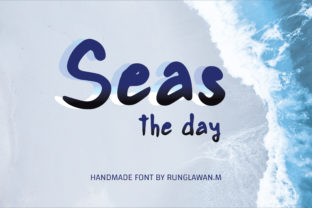
Seas the Day is a script font that stands apart—not by technical complexity or stylistic extremity, but by its quiet confidence and organic warmth. It’s not a display font built for shouting headlines, nor a utility script designed for rapid scanning. Instead, Seas the Day offers subtle rhythm, gentle contrast, and an unmistakable sense of hand-drawn ease—making it especially well-suited for projects where tone, personality, and approachability matter as much as legibility.
What Makes Seas the Day Distinct?
At first glance, Seas the Day appears deceptively simple: light weight, open letterforms, soft terminals, and consistent baseline flow. But its distinctiveness emerges in use. Unlike many script fonts that rely on dramatic flourishes or tight connections to imply elegance, Seas the Day uses spacing, proportion, and slight irregularity to suggest movement and breath. Letters like g, y, and Q feature relaxed descenders; capitals have gentle curves rather than sharp angles; and lowercase a and e avoid mechanical uniformity without sacrificing clarity.
This isn’t a font engineered for maximum character count per line—it’s designed for moments where readers pause, reflect, or feel invited in. Its lightness doesn’t mean fragility; rather, it signals intentionality. That makes Seas the Day especially effective in contexts where visual tone supports emotional resonance: boutique branding, editorial features, wedding stationery, artisan packaging, or thoughtful digital interfaces.
How It Fits Among Script Fonts
Script fonts fall along several practical dimensions: weight, connectivity, formality, x-height, and contextual flexibility. Seas the Day sits comfortably in the “light, semi-connected, low-formality” quadrant. It avoids the tight ligatures and dense texture of calligraphic scripts like Great Vibes or Dancing Script, and it lacks the bold contrast and assertive stance of high-contrast options such as Playfair Display Italic or Amatic SC.
Compared with more neutral sans-serif or serif typefaces, Seas the Day carries stronger voice—but unlike expressive display fonts, it doesn’t dominate. It works best when paired with a restrained companion: a modestly weighted sans-serif (like Inter or Lato) or a low-contrast serif (such as Cormorant Garamond or PT Serif). This pairing allows Seas the Day to serve as accent—not anchor—letting its charm emerge without overwhelming hierarchy or function.
Strengths in Practice
- Natural readability at moderate sizes: Its open counters and generous spacing support legibility down to ~16px in body text settings—uncommon for script fonts, which often require larger point sizes or tighter line heights to remain clear.
- Emotional consistency: It conveys warmth without saccharine affectation, playfulness without informality, and refinement without stiffness. This balance helps maintain brand cohesion across touchpoints—from email headers to printed product tags.
- Adaptability to color and texture: Because of its light weight and clean outlines, Seas the Day responds well to subtle gradients, soft shadows, or textured overlays—qualities that help it integrate into tactile or atmospheric design systems.
Tradeoffs and Realistic Limits
No script font excels everywhere—and Seas the Day is no exception. Its lightness becomes a limitation in environments demanding high contrast or long-distance visibility: signage, outdoor banners, or projected presentations under ambient light may reduce its impact or legibility. Similarly, its gentle stroke variation means it doesn’t scale as predictably as monoline or geometric scripts when used at very small sizes (e.g., caption text under images or micro-labels).
It also assumes a certain level of typographic awareness from the designer. Because Seas the Day relies on rhythm and spacing to communicate tone, poor tracking adjustments or inconsistent leading can flatten its expressiveness. Tightening letter-spacing too much risks making it feel cramped; loosening it excessively breaks its natural cadence. These aren’t flaws—they’re cues that Seas the Day rewards considered application over automatic use.
When Seas the Day Is Likely the Right Choice
Consider Seas the Day if your project prioritizes:
- Human-centered messaging: A wellness studio launching a new mindfulness course might use Seas the Day for section headers alongside clean body text—reinforcing calm and presence without resorting to clichéd “zen” motifs.
- Curated, small-batch identity: An independent ceramics brand could apply Seas the Day to product tags and thank-you notes, supporting a narrative of craftsmanship and care while avoiding overused handwritten alternatives.
- Editorial warmth: A long-form newsletter about sustainable living might use Seas the Day for pull quotes or subheadings—adding visual breathing room and tonal nuance without disrupting reading flow.
When Another Option May Serve Better
Seas the Day isn’t ideal for every scenario—even within the script category. If your use case requires:
- High legibility in constrained spaces: Think mobile app buttons, data dashboards, or multilingual interfaces where clarity trumps character—then a more neutral, highly legible script (or even a carefully chosen sans-serif italic) may be more appropriate.
- Strong historical or cultural reference: A brand rooted in 18th-century typography or Art Deco aesthetics may benefit more from a script with period-specific detailing—where Seas the Day’s contemporary simplicity could feel unintentionally anachronistic.
- Dynamic scaling across formats: If your system must render consistently across print, web, and video—especially with variable font support or responsive sizing—Seas the Day’s fixed weight and spacing may require more manual tuning than a variable script alternative.
Making a Practical Comparison
Choosing a script font isn’t just about liking how it looks—it’s about evaluating how it behaves across real conditions. Before committing to Seas the Day, test it in context:
- Set a paragraph of body copy at 18px with 1.5 line height—does it retain rhythm, or does spacing collapse visually?
- Try it in all-caps for a short headline: does the light weight hold up against surrounding elements, or does it recede too far?
- Apply it to a two-color palette (e.g., charcoal + warm taupe): does the contrast feel balanced, or does the font disappear against softer backgrounds?
Compare those results not only to other script fonts but also to non-script alternatives that fulfill similar expressive roles—for example, a lightly italicized serif or a rounded sans-serif with humanist proportions. Sometimes the most effective “script-like” effect comes not from a script at all, but from thoughtful emphasis within a more versatile family.
A Final Note on Intention
Seas the Day invites attention—not through volume, but through subtlety. Its value lies less in what it shouts and more in what it allows space for: clarity of message, authenticity of voice, and coherence of experience. That makes it especially useful for designers and communicators who understand that typography isn’t decoration—it’s part of the conversation.
If you’re weighing Seas the Day against other options, ask not just “Does this look right?” but “Does this support what the reader needs to feel, understand, and remember?” When the answer aligns across multiple touchpoints—and when its lightness serves purpose rather than merely style—Seas the Day earns its place with quiet authority.